Join the Gradeo waitlist today.

Past papers cannot predict the next HSC Aboriginal Studies exam, but they can show how the subject has been assessed over time.
We mapped HSC Aboriginal Studies exam items from 2015 to 2025 by answer type, directive verb, topic, marks and syllabus outcome. The purpose is not to guess future papers. It is to identify patterns that may help students and teachers check whether preparation is balanced.
This is a best-endeavours analysis of past papers and marking materials. Exam committees change, question design changes, and past emphasis does not guarantee future emphasis. Students should still prepare across the full syllabus and rely on official NESA materials, their teachers and their school's advice.
Across 2015 to 2025, the analysis mapped 328 items. The answer type breakdown was:
Short answer was the largest category by item count, while extended responses also appeared heavily across the mapped period.
This matters because Aboriginal Studies students need more than content recall. They need to explain, describe, analyse and discuss issues clearly, with appropriate examples and sensitivity to context.
Multiple choice appears consistently, but it is a smaller part of the assessment picture. The written sections are where students need to show depth, understanding and judgement.
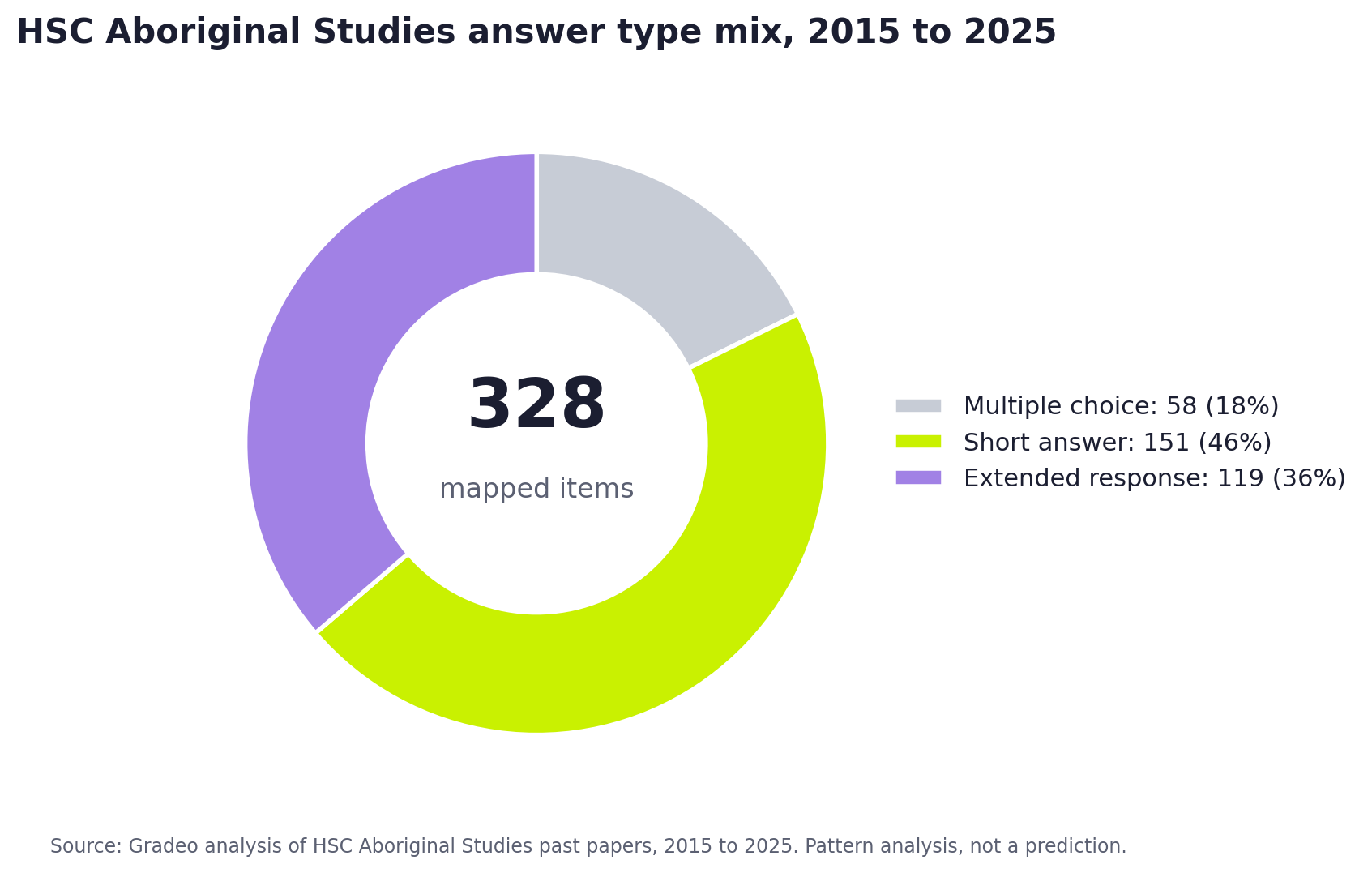
Short answer questions made up 151 of the 328 mapped items. This is important because short answer questions often reveal whether students understand the issue clearly enough to explain it without drifting into a general response.
A strong short answer usually needs:
The common risk is giving a broad statement about Aboriginal peoples, communities or issues without answering the specific question being asked. Students should practise short responses that are precise, contextual and evidence-based.
Extended responses made up 119 mapped items, which is a substantial share of the paper. This is one of the clearest preparation messages from the analysis. Students need to build confidence writing sustained responses, not just short explanations.
Extended responses in Aboriginal Studies require students to handle complex issues carefully. They often need to bring together:
Students should practise extended responses regularly. The challenge is not simply writing more. It is selecting relevant content, structuring the argument and using examples in a way that directly supports the question.
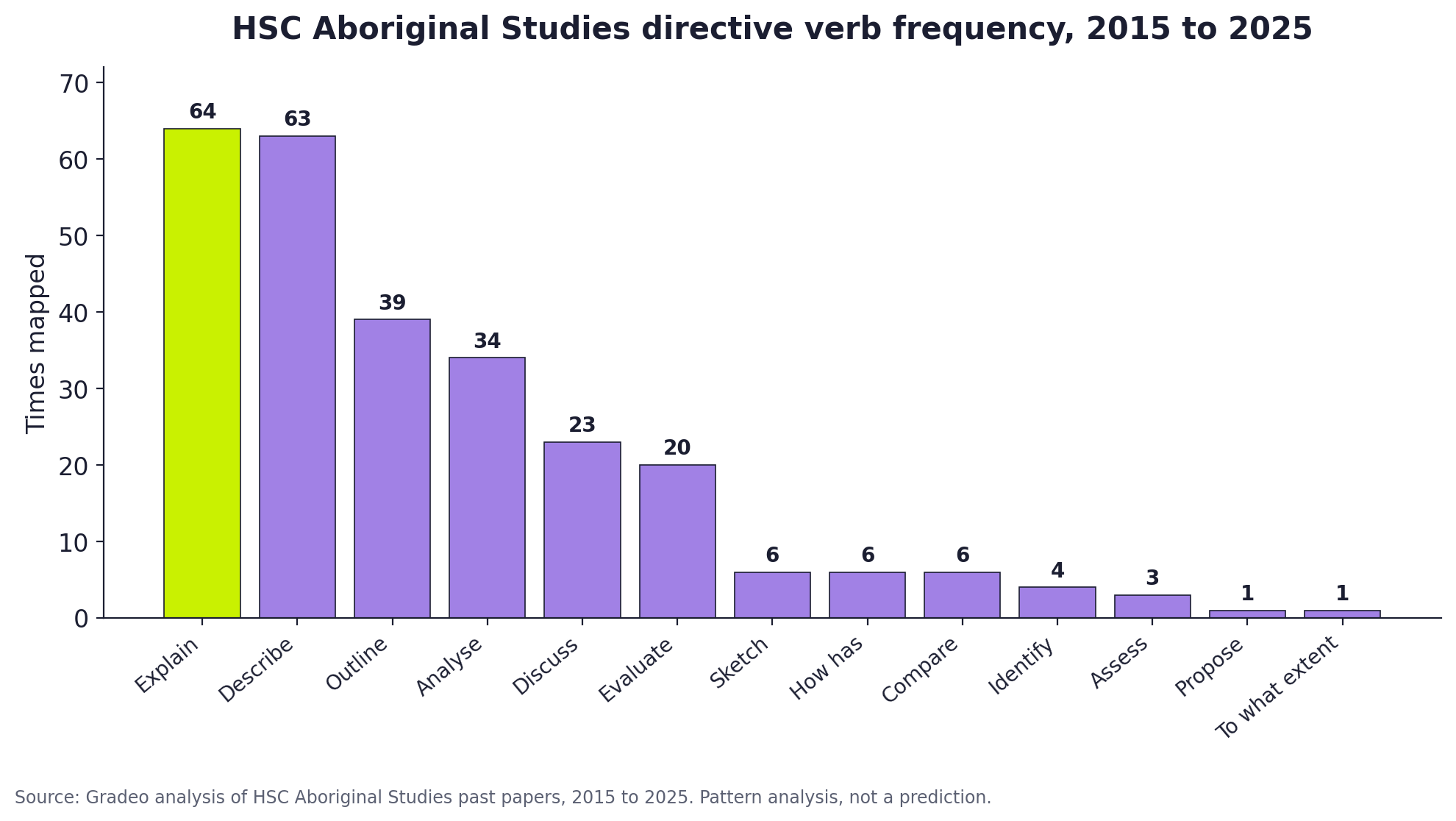
The two most common directive verbs were Explain and Describe. Across the mapped period:
Together, Explain and Describe accounted for almost 40 per cent of mapped directive verbs.
This is useful because it shows students need to be fluent in both description and explanation. Describe usually requires students to give characteristics, features or details. Explain requires students to show how or why something occurs, or why it matters. Those are different tasks.
A student who describes when asked to explain may not go far enough. A student who explains generally without describing the specific issue may also lose clarity. Good practice should include answering the same topic under different directive verbs. For example:
Evaluate appeared 20 times, Assess appeared 3 times, and To what extent appeared once across the mapped period. These are less frequent than Explain, Describe and Outline, but they often appear in extended response contexts where marks are higher and judgement matters more.
Students should be prepared to do more than present information. They need to be able to weigh impact, effectiveness, change, continuity or significance. A strong evaluative response should usually:
This is where students can move from a descriptive response to a stronger analytical one.
Global Perspective had the highest mapped coverage by both question count and marks. The mapped topic coverage was:
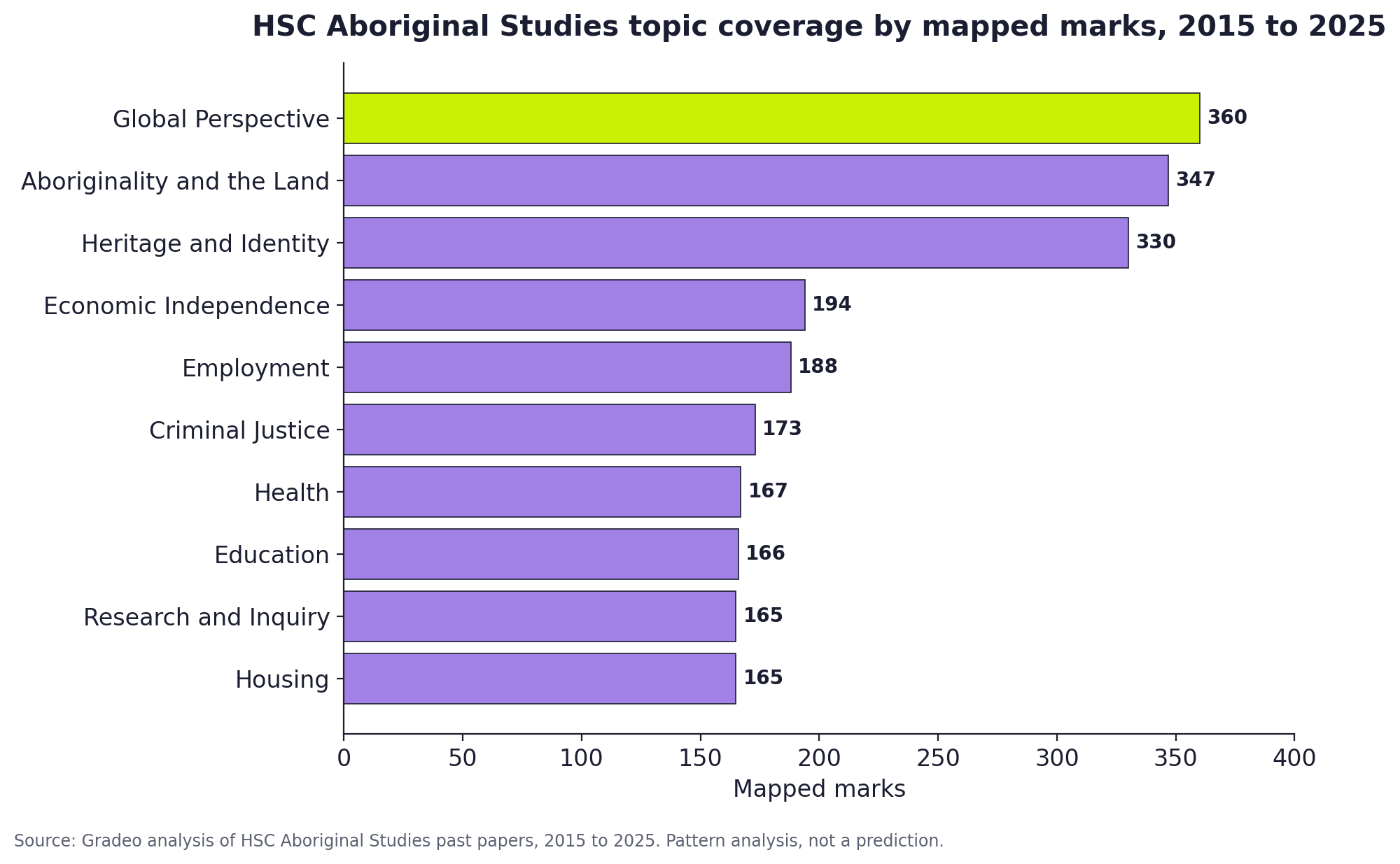
Global Perspective stands out by item count and marks, but this should not be used to narrow study. Aboriginality and the Land and Heritage and Identity also carried very high mark totals, despite fewer mapped items. The better insight is that some areas appear through fewer but higher-value questions. That is particularly important for core topics and extended responses.
Aboriginality and the Land had 35 mapped items but 347 mapped marks. Heritage and Identity had 22 mapped items but 330 mapped marks. That is a very important distinction.
If students only look at question count, they may underestimate these areas. By marks, they are among the most significant parts of the mapped papers. This suggests that students need strong preparation for deeper, higher-value responses in the core areas. It is not enough to have surface-level notes. Students should be able to write sustained responses that connect core concepts to examples, impacts and perspectives.
The six depth study areas were relatively close by mapped marks:
The spread is not large enough to justify excluding any depth study from preparation. Students should be able to work confidently across all six, especially because questions may require comparison, explanation of issues, or discussion of responses and outcomes.
A sensible preparation approach is to make sure each depth study has:
Research and Inquiry had 26 mapped items and 165 mapped marks. That places it close to Education, Health and Housing by marks.
This is worth noting because students can sometimes treat research skills as secondary to content. The mapping suggests that inquiry skills are a consistent part of the assessment picture. Students should be comfortable with:
This is a good area for short, frequent practice because it can be improved through repeated exposure to sources and stimulus material.
The outcome mapping shows H1.2 appearing most frequently across sections. H1 outcomes related to Aboriginality and H3 outcomes related to enquiry skills appeared consistently across both multiple choice and short answer and written sections. H4 outcomes related to global perspective featured more heavily in extended responses.
This fits the broader pattern of the subject. Students need to understand Aboriginality, identity, land, heritage, social justice issues and global perspectives, but they also need the skills to interpret, analyse and use evidence. This is not a subject where memorising dot points is enough. Strong responses need accurate content, relevant examples and careful explanation.
Students should use this analysis as a preparation check. Useful questions to ask:
The wrong use of this analysis is to try to predict the next paper. The right use is to find gaps in preparation.
For teachers, the analysis may be useful as a planning check. It can help identify whether students are getting enough extended response practice, whether they understand directive verbs, whether the depth studies are being revised evenly, and whether source and inquiry skills are being practised enough.
It may also support targeted practice. For example:
This analysis has limits.
It is a pattern analysis, not a prediction model.
The Aboriginal Studies papers from 2015 to 2025 suggest a subject that is strongly written-response based, with major emphasis on short answer and extended response.
Students need to be comfortable describing and explaining, but also analysing, discussing and evaluating where required. Global Perspective had the highest mapped coverage, while Aboriginality and the Land and Heritage and Identity carried very high mark totals despite fewer mapped items. The six depth studies were fairly balanced by marks, so students should not narrow their preparation too heavily.
The most useful takeaway is to practise precise, evidence-based responses across the whole course. Past paper analytics can help identify patterns, but they should not be treated as a forecast.
No. Past papers can show previous patterns, but they cannot predict future papers.
This analysis covers HSC Aboriginal Studies papers from 2015 to 2025.
Short answer appeared most often, with 151 mapped items across the period analysed.
Explain and Describe were the most common, appearing 64 and 63 times respectively.
Global Perspective had the highest mapped coverage by both item count and marks, with 74 items and 360 marks.
No. Global Perspective was prominent, but core topics such as Aboriginality and the Land and Heritage and Identity also carried very high mapped marks. Students should prepare broadly.
The six depth studies were relatively balanced by mapped marks, so students should prepare all six.
Practise short and extended responses, understand directive verbs, use specific examples, and prepare across the whole course rather than trying to predict the next paper.
.png)


Book a demo to see how Gradeo can help create, deliver, mark and analyse assessments in one secure platform.
