Join the Gradeo waitlist today.

Past papers cannot predict the next HSC Ancient History exam, but they can show how the current syllabus has been assessed so far.
We mapped HSC Ancient History exam items from 2019 to 2025 by answer type, directive verb, course component, marks and syllabus outcome. The purpose is not to guess future papers. It is to identify patterns that may help students and teachers check whether preparation matches the way the paper works.
This is a best-endeavours analysis of past papers and marking materials. Exam committees change, question design changes, and past emphasis does not guarantee future emphasis. Students should still prepare across the full syllabus and rely on official NESA materials, their teachers and their school's advice.
Across 2019 to 2025, the analysis mapped 546 Ancient History items. The answer type breakdown was:
There is no multiple-choice section. That matters because every mark in Ancient History depends on constructed historical writing. Students need to explain, describe, assess, evaluate and discuss. They need to use evidence and shape their knowledge into a response that answers the question.
This is not a subject where students can rely on recognition. They have to produce the answer.
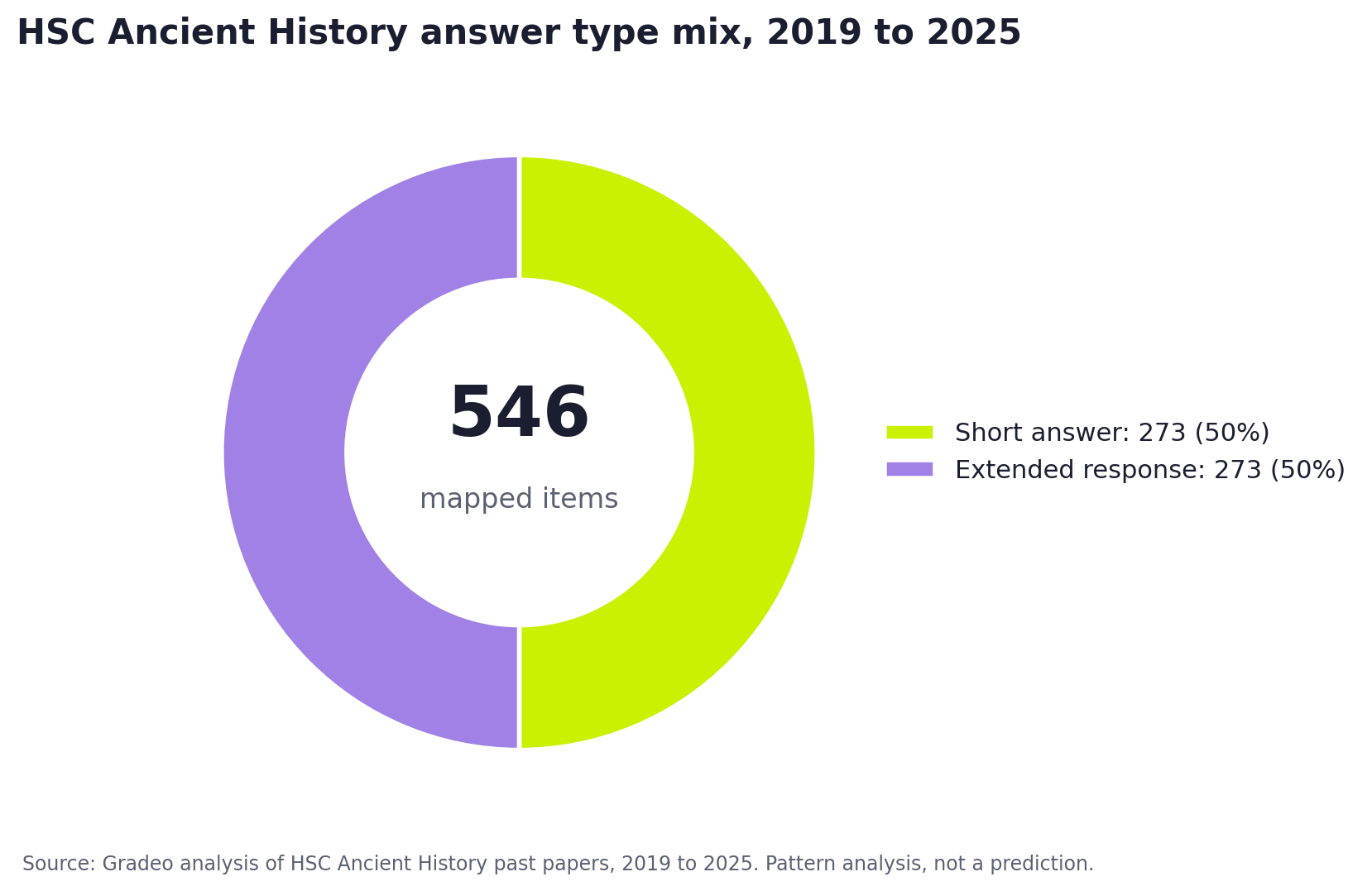
The split between short answer and extended response was exactly the same each year in the mapped period: 39 short-answer items each year and 39 extended-response items each year.
That stability is useful because students know the shape of the exam. But it also means preparation needs to match the paper's rhythm. Students need to be ready for:
The exam does not only test whether students know the content. It tests whether they can choose the right material, use it under time pressure and write in the form required by the section.
Historical Periods is the clearest mark-weight pattern in the analysis. Across 2019 to 2025, the mapped course component coverage was:
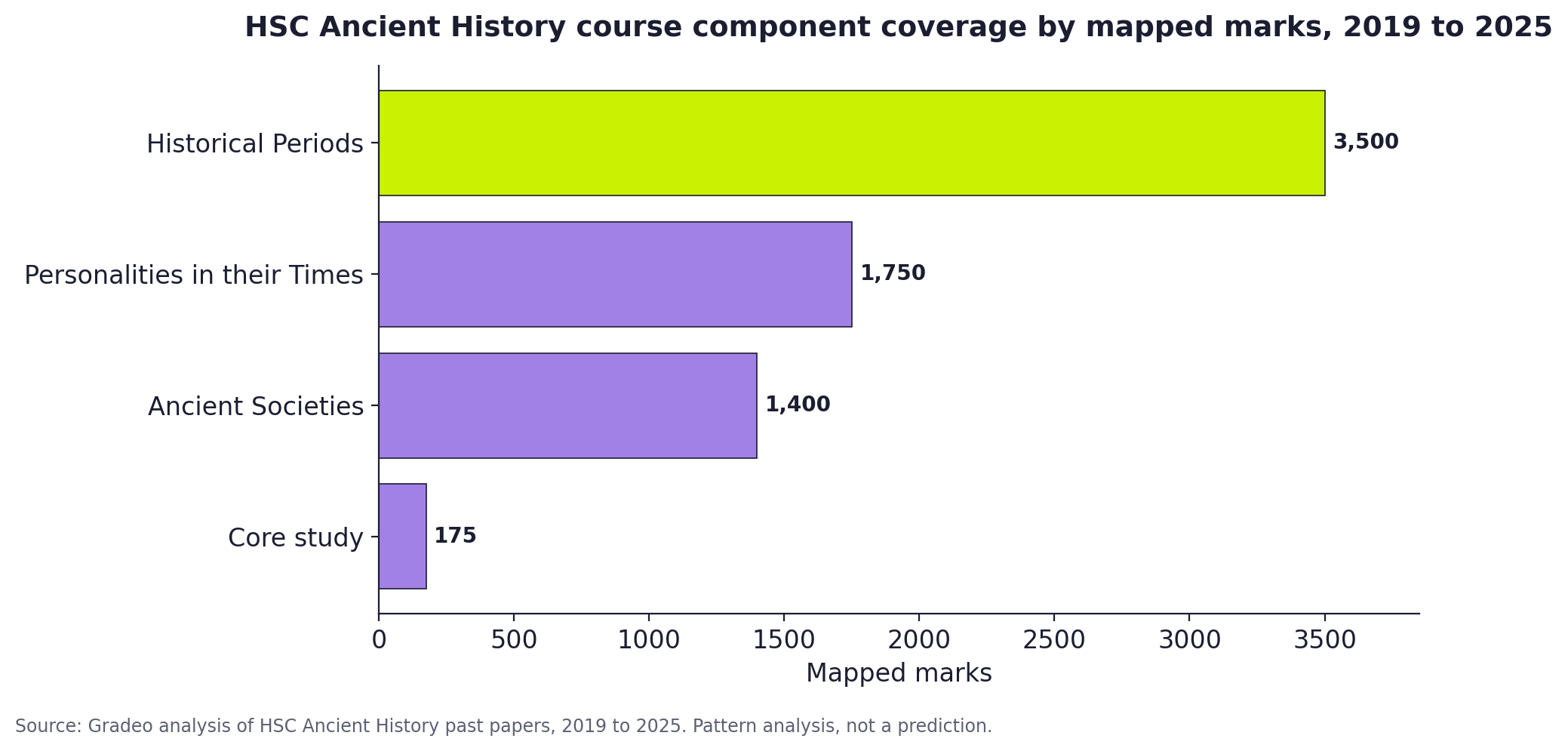
Historical Periods has fewer items than Personalities in their Times, but it carries twice the mapped marks because each extended response is worth up to 25 marks. This is one of the most important preparation points.
Students cannot treat Historical Periods as simply another content area. It is where sustained argument, evidence, judgement and structure carry major weight. A student may know the period well, but still lose marks if they cannot build a clear historical argument.
The contrast between item count and mark weight is important. Personalities in their Times had the highest mapped item count, with 210 items, while Historical Periods had 140 items. But Historical Periods carried 3500 mapped marks, compared with 1750 for Personalities in their Times.
That means students who judge importance by number of questions may misread the paper. Shorter or more numerous questions matter, but the high-value extended responses shape the final result. Preparation should reflect both. Students need quick accuracy for shorter responses and sustained depth for extended writing.
Ancient Societies carried 1400 mapped marks, while Personalities in their Times carried 1750. These sections are significant and should not be treated as supporting areas only.
For Ancient Societies, students need to handle specific features of society, relevant evidence and clear explanation. For Personalities in their Times, students need to connect the individual to their historical context, actions, impact, significance and interpretation.
The risk in both sections is writing a prepared summary rather than answering the exact question. Students should practise adapting evidence and examples to different directive verbs.
The directive verb mapping shows how important higher-order historical judgement is. Across the mapped period:
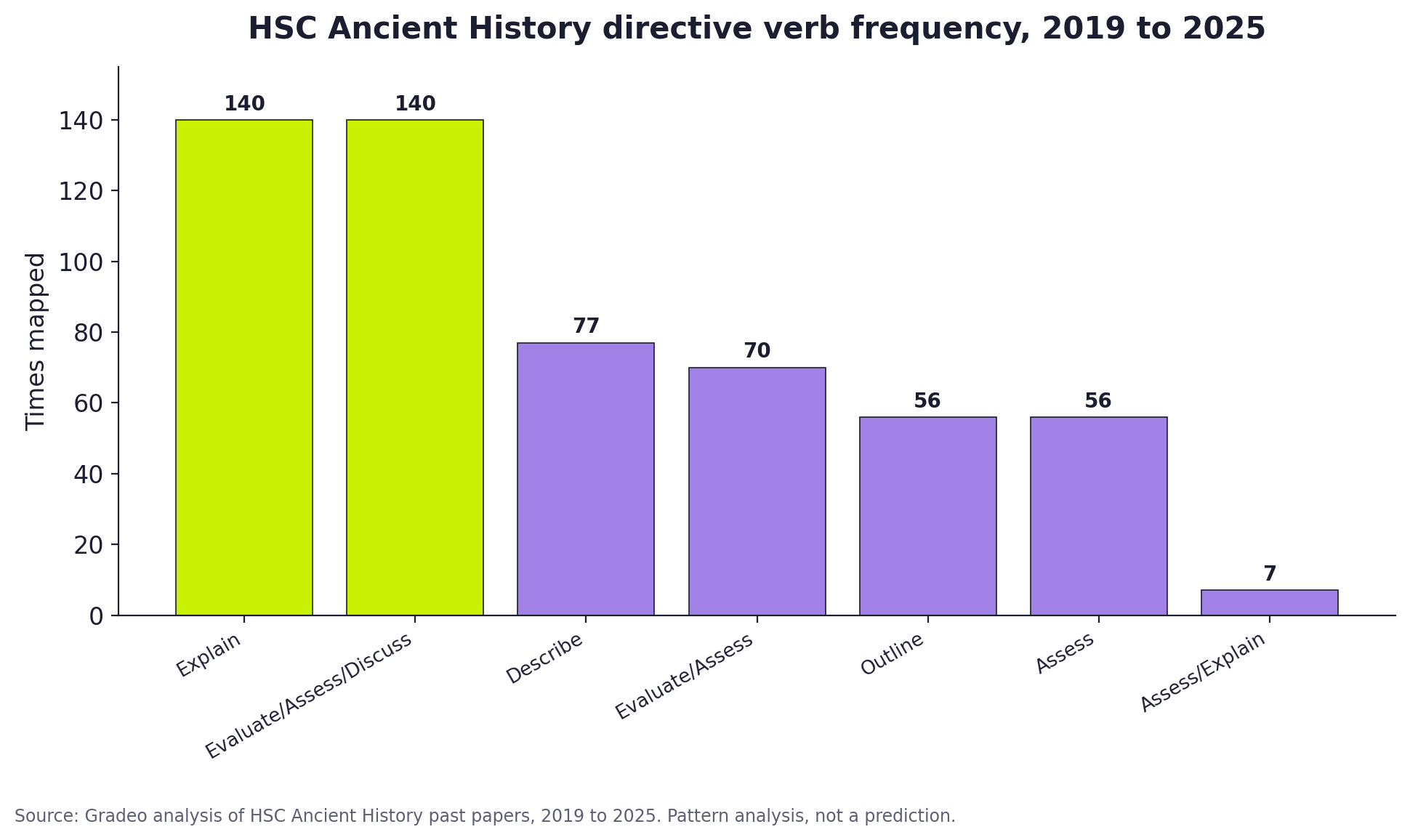
This is not a recall-heavy directive profile. Explain requires students to show why something happened or why it mattered. Assess, Evaluate and Discuss require judgement, weighing evidence and considering significance.
Students should practise moving from narrative to argument. A response that only tells the story may not be enough. Stronger responses use the story to make a point.
Because Explain and the evaluative directive groups both appeared 140 times, students need to practise both.
An Explain response should usually make relationships clear:
An Assess or Evaluate response needs judgement:
This distinction matters. Students who describe when asked to assess may show knowledge but not enough historical judgement.
The outcome mapping shows AH12-9, evaluating historical perspectives, as the most heavily assessed outcome across written sections, with 462 mapped appearances. That aligns with the nature of the subject. Ancient History rewards students who can work with evidence and historical perspectives, not just recall content.
Students need to practise:
Evidence should not be inserted mechanically. It should do work in the answer.
The Core study had the smallest mapped mark total, with 175 marks across the period. That does not mean it can be ignored.
The Core study can set the tone for the exam and tests source-based skills that are important across the subject. Students need to read evidence carefully, answer directly and avoid over-writing when the question is narrow. Good Core study preparation includes:
These are also transferable skills for the rest of the exam.
Students should use this analysis as a preparation check. Useful questions to ask:
The wrong use of this analysis is to try to predict the next question. The right use is to check whether preparation matches the demands of the paper.
For teachers, the analysis may be useful as a planning check. It can help identify whether students are getting enough high-value extended response practice, whether they are over-relying on narrative, and whether they understand the difference between explanation and evaluation.
It may also support targeted practice. For example:
This analysis has limits.
It is a pattern analysis, not a prediction model.
The Ancient History papers from 2019 to 2025 show a highly stable exam structure and a strong emphasis on written construction.
The key insight is the mark weight of Historical Periods. It accounts for over half of the mapped marks, despite having fewer items than some other components. Students need to practise sustained historical argument, not just content recall.
The directive verb pattern also matters. Explain, Assess, Evaluate and Discuss are central to the exam. Students need to use evidence, handle perspectives and make supported judgements. Past paper analytics can help students and teachers check whether preparation is balanced. They should not be used to predict the next paper.
No. Past papers can show previous patterns, but they cannot predict future papers.
This analysis covers HSC Ancient History papers from 2019 to 2025, the current syllabus period.
No. In the mapped period, the exam consisted entirely of short answer and extended response items.
Historical Periods carried the most mapped marks, with 3500 marks across the 2019 to 2025 papers analysed.
Each Historical Periods extended response is worth up to 25 marks, so the section carries major weight even though it has fewer items than some other components.
Explain and the combined Evaluate, Assess or Discuss group were tied as the most frequent directive groups, each appearing 140 times.
Practise sustained historical argument, use evidence effectively, understand directive verbs and avoid relying on narrative alone.
Teachers can use it to check whether students are getting enough extended response practice, especially in Historical Periods, and whether they are developing judgement rather than only recalling content.
.png)


Book a demo to see how Gradeo can help create, deliver, mark and analyse assessments in one secure platform.
