Join the Gradeo waitlist today.

.svg)
Past papers cannot predict the next HSC Biology exam, but they can show how the current syllabus has been assessed so far.
We mapped HSC Biology exam items from 2019 to 2025, covering the current syllabus period. The analysis looked at answer types, directive verbs, modules, marks and outcomes.
This should be treated as a guide to past patterns, not a forecast. Exam committees change, question design changes, and past emphasis does not guarantee future emphasis. Students should still prepare across the full syllabus and rely on official NESA materials, their teachers and their school's advice.
The fixed structure means multiple choice appears every year, with 20 questions in each paper. Across 2019 to 2025, that produces 140 multiple-choice items. That is not the main insight. It is part of the exam design.
The more useful point is that students need to move between very different kinds of thinking across the paper. Multiple choice tests breadth, accuracy and careful reading. Short answer tests concise explanation and application. Extended responses test depth, reasoning and control of evidence. Calculation, table, graph and diagram questions test whether students can work scientifically, not just recall content.
A good Biology study plan should therefore include regular practice across formats, not only content revision.
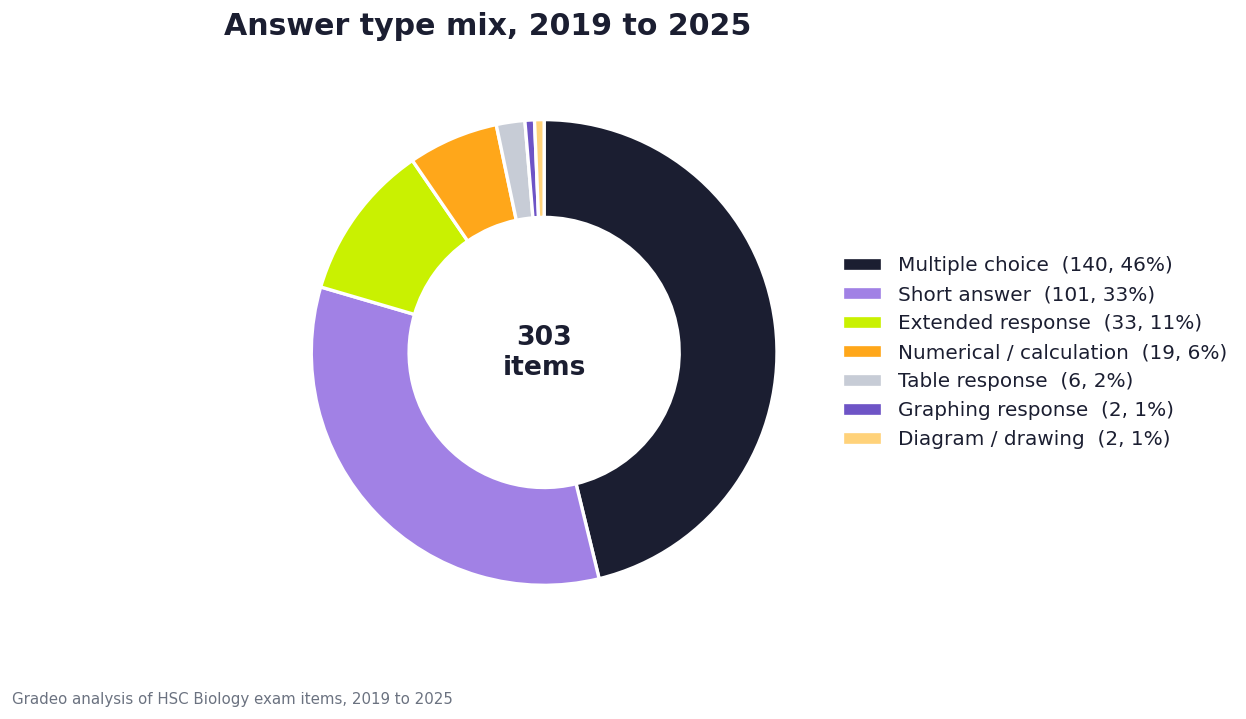
Short answer was the largest written-response category in the mapping, with 101 items from 2019 to 2025. That matters because short answer is where many Biology students lose marks through vague explanation.
A student may know the content, but still lose marks if they do not:
Short answer practice should not be treated as quick revision only. It is one of the best ways to test whether students can apply the syllabus under exam conditions.
Extended response items appeared 33 times across the mapped period. The number of extended response items varies by year, but the preparation need remains consistent: students must be able to build a coherent biological explanation across several marks.
In Biology, stronger extended responses usually do more than list facts. They show relationships between processes, interpret evidence, and connect the biology to the question being asked. Students should practise extended responses that require them to:
This is especially important because Biology often rewards precise reasoning rather than long generalised responses.
Numerical or calculation-style responses appeared 19 times across 2019 to 2025, with at least one such item in every year mapped. Biology is not a calculation-heavy subject, but students cannot ignore data. The more important skill is usually not the arithmetic by itself. It is the interpretation.
Students should be comfortable with:
This is a useful practice area because students often think they understand a concept until they have to apply it to unfamiliar data.
Table responses appeared six times across the mapped period, all in 2024 and 2025. Graphing responses appeared twice, both in 2024. Diagram or drawing responses appeared twice, in 2021 and 2024. These are small numbers, so they should not be overstated.
The useful point is that Biology students should be ready to respond in formats other than prose. The exam can ask students to organise information, interpret data, complete a table, construct or interpret a graph, or use a diagram to communicate understanding. That is a different skill from writing a paragraph. Students should practise:
Even when these formats appear only occasionally, they can be uncomfortable for students who have only practised written explanations.
The directive verb mapping shows a clear pattern: Biology frequently asks students to explain biological relationships. The largest mapped directive category was Explain / describe, with 54 appearances. Other common directive categories included Determine / explain with 17 appearances, Explain / evaluate with 16, and Explain with 14. Together, explain-containing categories accounted for 101 of the 163 mapped directive entries.
This is one of the most useful findings. Biology students should not practise definitions alone. They need to practise explaining how and why biological processes occur. For example, there is a difference between:
Students who can only recall content may struggle when asked to explain relationships, interpret evidence or justify conclusions.
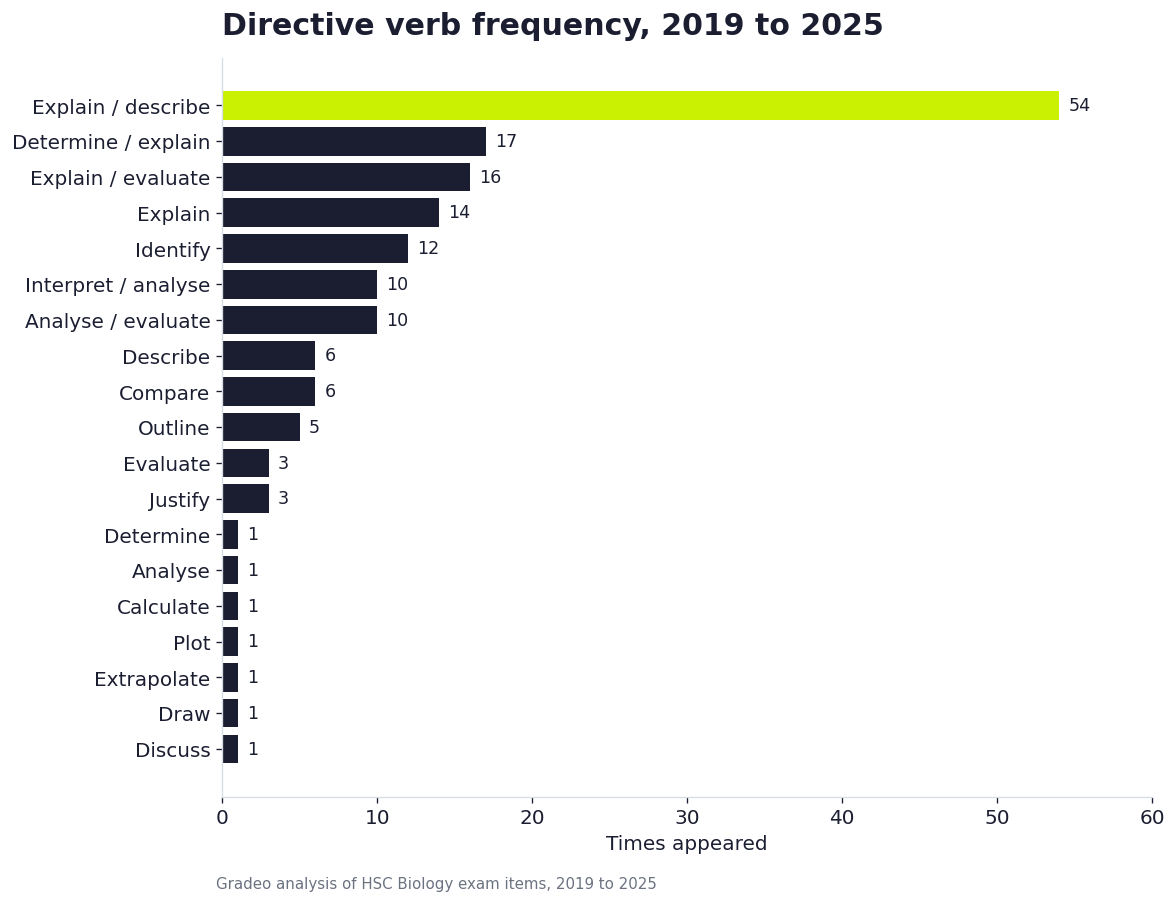
Although explain-type demands dominate, the mapping also includes identify, interpret, analyse, evaluate, compare, outline, justify, determine, calculate, plot, extrapolate, draw and discuss. That variety matters. Biology questions can shift quickly between recall, interpretation, data analysis and evaluation. Students need to be ready for that shift.
A useful revision exercise is to take one syllabus concept and practise it under different question demands. For example:
That kind of practice helps students move beyond memorised notes.
The four Year 12 Biology modules were all strongly represented across 2019 to 2025. Using proportional allocation for cross-module questions, the mapped coverage was approximately:
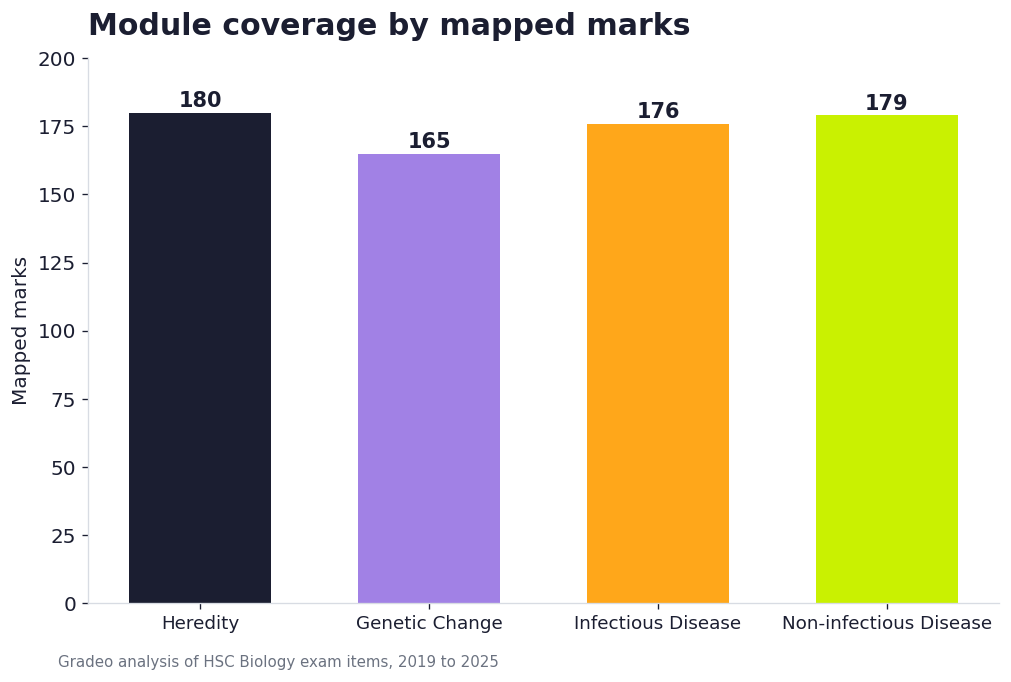
Heredity had the highest item count and the highest mapped marks, but the overall mark spread is fairly even. The difference between the highest and lowest mapped module mark totals is only 15 marks across seven papers. That is a strong warning against topic guessing. Students should prepare all four modules properly. The data does not support narrowing study to one or two likely modules.
Heredity led the mapping by both item count and marks. That is worth noticing, but it should be interpreted carefully. The gap is not large enough to justify over-focusing on Heredity. Genetic Change, Infectious Disease and Non-infectious Disease and Disorders all received substantial and recurring coverage.
The better takeaway is that Heredity is a useful check on depth. Students should be confident with inheritance, variation, reproduction, DNA, cell replication and related concepts, but they still need strong preparation across disease, immunity, technologies, epidemiology and homeostasis. In other words: notice the pattern, but do not let it narrow the study plan.
The outcome mapping suggests that content outcomes across the Year 12 modules dominate, as expected. However, working scientifically outcomes also appear consistently, particularly in written questions. This is important because Biology is not assessed as content recall alone.
Students need to show that they can:
For students, this means notes are not enough. They need regular practice applying content to unfamiliar information. For teachers, it suggests value in practice tasks that combine content with data, stimulus and scientific reasoning.
Students should use the analysis as a revision audit. Useful questions to ask:
The wrong use of this analysis is to try to predict the next paper. The right use is to find neglected skills.
For teachers, the analysis may be useful as a planning check. It can help identify whether revision is too content-heavy, whether students are getting enough data interpretation practice, whether extended response writing is being rehearsed, and whether all four modules are receiving balanced attention.
It may also support targeted practice. For example:
This analysis has limits.
It is a pattern analysis, not a prediction model.
The current syllabus Biology papers from 2019 to 2025 suggest a fairly balanced exam across the four Year 12 modules, with strong emphasis on explanation, data interpretation and applying biological concepts.
The most useful insights are practical. Students should practise short answers carefully, not just as quick revision. They should be ready for calculations and data interpretation every year. They should practise occasional table, graph and diagram formats. They should treat explain-type questions as a central skill, not a simple directive verb.
Most importantly, students should avoid using past papers to guess. The safer and more useful approach is to use past paper trends to check whether preparation is balanced across modules, answer formats and scientific reasoning skills.
No. Past papers can show how Biology has been assessed in previous years, but they cannot predict future papers.
This analysis covers HSC Biology papers from 2019 to 2025, the current syllabus period.
Using proportional allocation for cross-module questions, Heredity had the highest mapped item count and marks. However, coverage across all four Year 12 modules was broadly even.
No. Heredity led slightly in the mapping, but all four modules were strongly represented. Students should prepare Heredity, Genetic Change, Infectious Disease and Non-infectious Disease and Disorders.
Numerical or calculation-style responses appeared in every year from 2019 to 2025, with 19 mapped items overall. Students should practise calculations and, more importantly, interpreting what the results mean in biological terms.
Explain-type questions dominate the mapping. Students should practise explaining biological processes, relationships and evidence, not just identifying or describing content.
They appear only occasionally as explicit response types, but students should still practise tables, graphs and diagrams because Biology often requires data interpretation and visual communication.
Prepare broadly across all modules, practise short answers and extended responses, build confidence with data and calculations, and focus on explaining biological relationships clearly.
.png)


Book a demo to see how Gradeo can help create, deliver, mark and analyse assessments in one secure platform.
