Join the Gradeo waitlist today.

Past HSC papers cannot predict the next Business Studies exam, but they can help students and teachers understand how the subject has been assessed over time.
We mapped HSC Business Studies exam items from 2015 to 2025 by answer type, directive verb, business function, marks and syllabus outcome. The point of this analysis is not to guess what NESA will ask next. It is to identify patterns that may help students practise more deliberately.
This is a best-endeavours analysis of past papers and marking materials. Exam committees change, question design changes, syllabuses can be updated, and past emphasis does not guarantee future emphasis. Students should still prepare across the full syllabus and rely on official NESA materials, their teachers and their school's advice.
Multiple choice is the largest category by item count, with 20 questions each year and 220 mapped items across 2015 to 2025. That is not really an insight. It reflects the exam structure.
The useful point is that Business Studies students need to prepare for different kinds of thinking across the paper. Multiple choice rewards syllabus breadth, terminology and precision. Short answer rewards direct application. Business reports and extended responses reward structure, judgement and the ability to use business strategies in context.
A student who prepares only by writing long responses may miss quick, precise marks in multiple choice and short answer. A student who only drills shorter questions may struggle with the sustained structure needed in reports and extended responses.
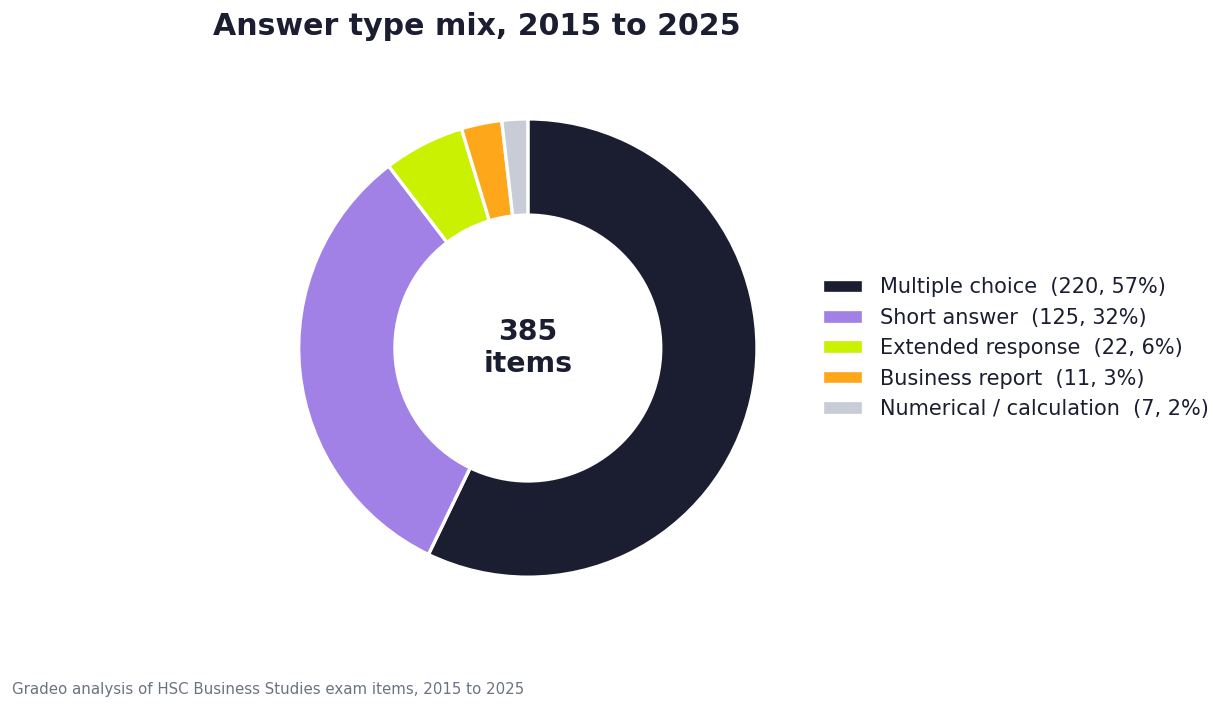
Short answer questions appeared 125 times across the mapped period. This is where a lot of Business Studies marks are won or lost because the questions are often narrow enough to expose weak understanding quickly. The issue is usually not whether students know a term. It is whether they can answer the exact question in the right depth.
Short answers often require students to:
For teachers, short answer is also a useful diagnostic section. If a class is weak here, the issue may be application, terminology, directive verbs or time management rather than topic knowledge alone.
The analysis confirms what teachers already know from the paper structure: the business report is a recurring feature, appearing once in every year mapped.
That consistency is useful because report writing is one of the most trainable parts of the course. Students can improve by practising structure, headings, recommendations, scenario application and the use of relevant business terminology. The common weakness is writing a generic prepared response rather than a report that actually responds to the business situation. Stronger students tend to make the structure work for the scenario, not the other way around.
Students should practise business reports as a format, not just as a content exercise. Useful practice includes:
Numerical or calculation-style responses are still a small part of the mapped paper, with seven mapped items across the period. The interesting part is that these appeared from 2020 onwards. That does not mean Business Studies has become calculation-heavy. It has not.
But it does suggest students should be comfortable with financial data and interpretation. The calculation itself is often only part of the task. The stronger response usually explains what the result means for business performance.
Students should practise:
This is a good targeted revision area because some students avoid it until late in the course.
Explain was the most common written-question directive verb in the mapped papers, appearing 41 times from 2015 to 2025. The next most frequent directive verbs and question starters included Outline, How, Recommend, Describe, Why, Discuss, Analyse, Justify and Evaluate.
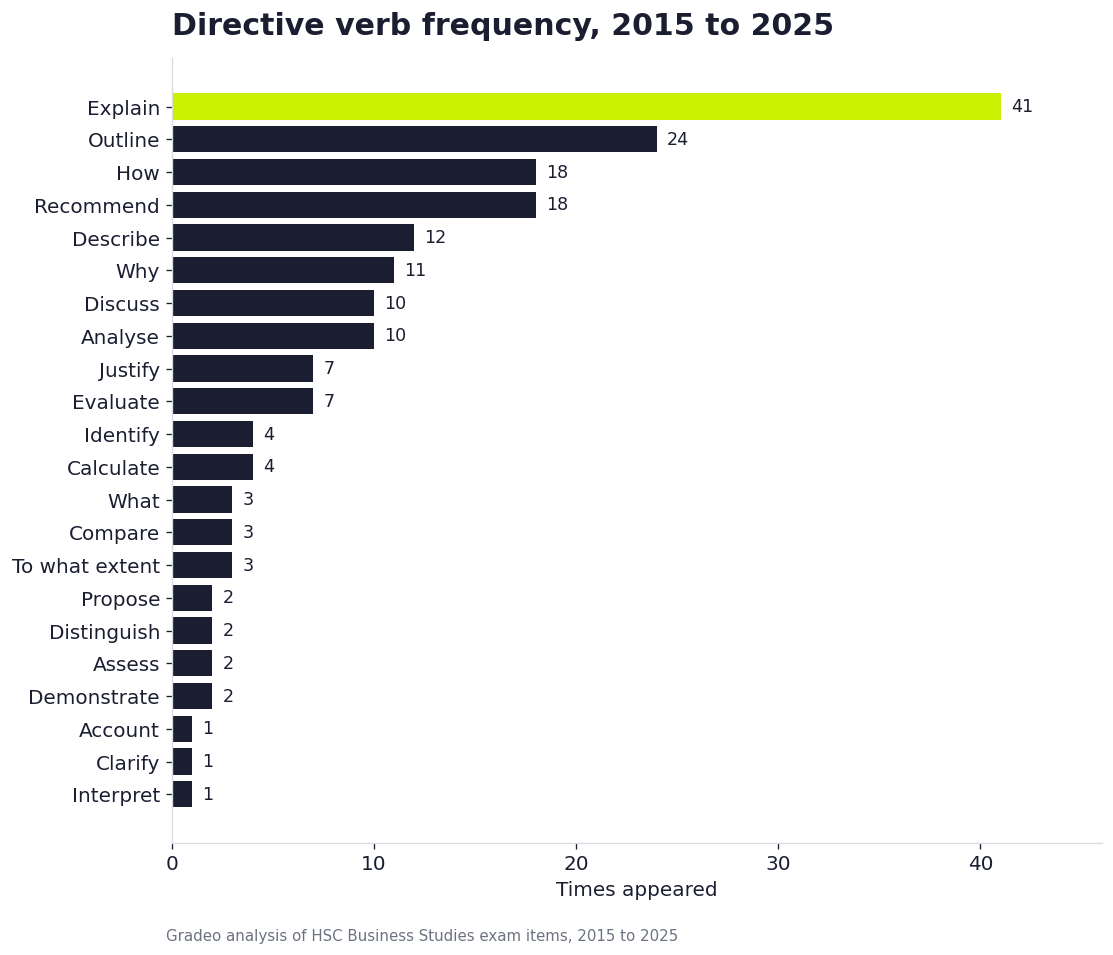
This is one of the more useful findings because it points to a specific practice need. In Business Studies, Explain usually asks for more than identifying or describing a concept. Students need to show how or why something happens. That means cause and effect.
For example, if a question asks students to explain how a marketing strategy may improve performance, the answer needs to connect the strategy to a likely business outcome. It should not just define the strategy.
A good revision exercise is to take the same concept and answer it under different verbs:
That helps students stop relying on memorised paragraphs and start responding to the actual task.
Across the 2015 to 2025 mapping, Operations and Marketing received the greatest coverage by mapped marks:
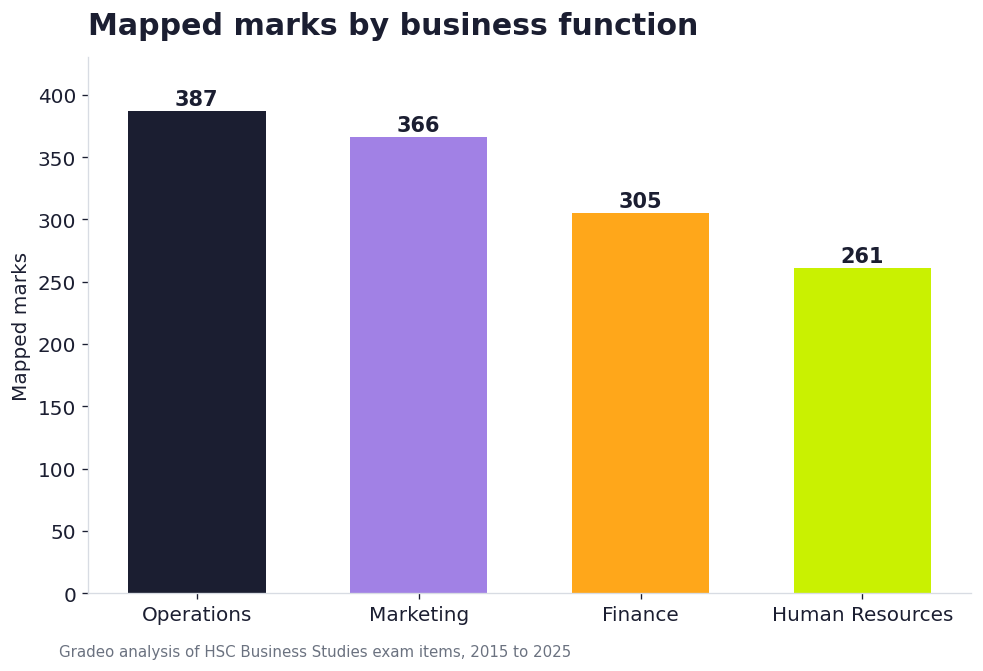
This should not be used to narrow study. It does not mean Operations or Marketing are more likely in a future paper. The more useful reading is that Operations and Marketing have carried substantial mark weight across the period, while Finance and Human Resources remain regular and important. Human Resources was the lowest of the four by mapped marks, but it still appeared across the period and can be examined in high-value formats.
Students should not use this data to skip anything. They should use it to check whether their practice is balanced.
By question count, the four business functions were closer:
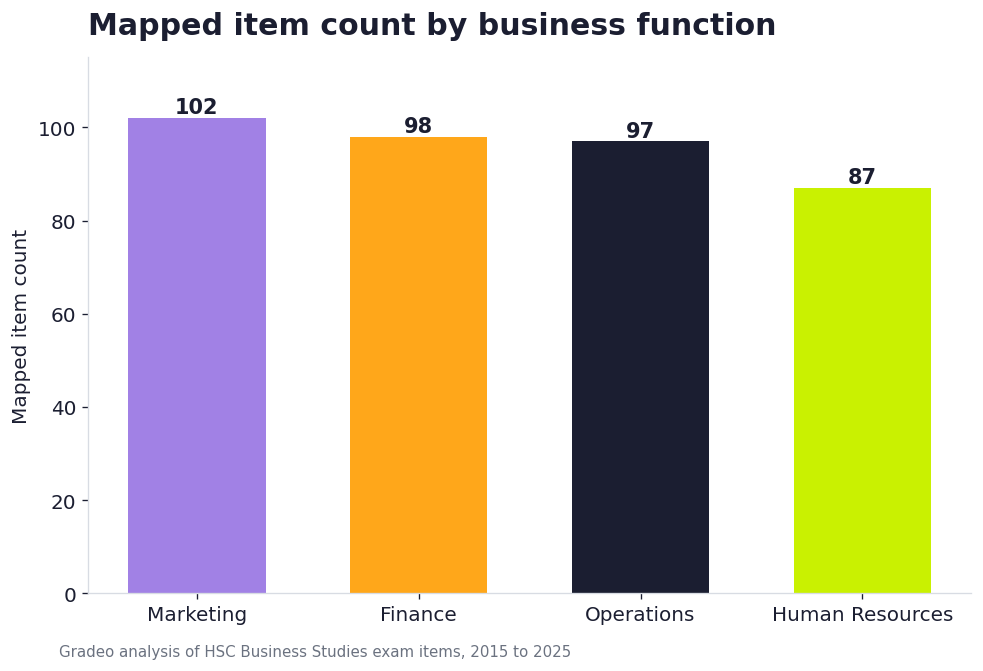
This is a useful distinction. A function can appear often through lower-mark items, or less often but in higher-value questions. That means counting questions alone can mislead students. The practical lesson is that revision should cover both frequency and depth. Students need quick recall for smaller items, but also enough depth to handle business reports, extended responses and higher-mark short answers.
The mapped outcome coverage points towards application, strategy and business impact. H2, H4 and H5 were among the most heavily represented outcomes across the analysed papers, with H2 and H5 especially prominent in written responses.
That aligns with the broader pattern in the paper. Business Studies does not only reward students for knowing definitions. It rewards students who can explain relationships between strategies, business functions, influences and performance.
Students should therefore practise responses that move from concept to business consequence:
This is where many mid-range answers can improve. The content may be correct, but the link to business impact is too weak.
The safest use of this analysis is as a revision audit. Students should ask:
The wrong use of this analysis is to say, Operations and Marketing have appeared more by marks, so I can focus on those. That is too risky. The right use is to identify neglected practice areas.
For teachers, the analysis is useful as a planning check. It can help identify whether a revision program is too heavily weighted towards content recall, whether students are getting enough timed short-answer practice, whether report writing is being rehearsed properly, and whether Finance or Human Resources are being under-practised.
It can also support more targeted practice. For example:
The HSC Business Studies paper is stable in structure, but it is not predictable in content.
The data from 2015 to 2025 suggests that effective preparation should focus on balance and application. Students need to practise the full paper, not just favourite sections. They need to understand directive verbs, especially Explain. They need to cover all four business functions, while recognising that Operations and Marketing have carried strong mark weight in the mapped period. They should also practise financial interpretation, even though calculation questions remain a small part of the paper.
The most useful takeaway is simple: do not use past papers to guess. Use them to find gaps in preparation.
No. Past papers can show patterns in past assessment, but they cannot predict future papers.
Explain was the most common written-question directive verb, appearing 41 times in the mapped 2015 to 2025 period.
Operations and Marketing carried the most mapped marks across the period analysed, followed by Finance and Human Resources.
No. All four business functions need to be prepared. The data is useful for checking balance, not narrowing study.
They are a small part of the mapped paper, but numerical and financial interpretation appeared from 2020 onwards. Students should be able to calculate, interpret and explain financial information in business terms.
Practise the whole paper, answer directive verbs precisely, rotate across all four business functions, and focus on applying syllabus knowledge to business situations.
.png)


Book a demo to see how Gradeo can help create, deliver, mark and analyse assessments in one secure platform.
