Join the Gradeo waitlist today.

Past papers cannot predict the next HSC Community and Family Studies exam, but they can show how the subject has been assessed over time.
We mapped HSC CAFS exam items from 2015 to 2025 by answer type, directive verb, content area, marks and syllabus outcome. The purpose is not to guess future papers. It is to identify patterns that may help students and teachers check whether preparation is balanced.
This is a best-endeavours analysis of past papers and marking materials. Exam committees change, question design changes, and past emphasis does not guarantee future emphasis. Students should still prepare across the full syllabus, their selected option topic, official NESA materials and their teacher's advice.
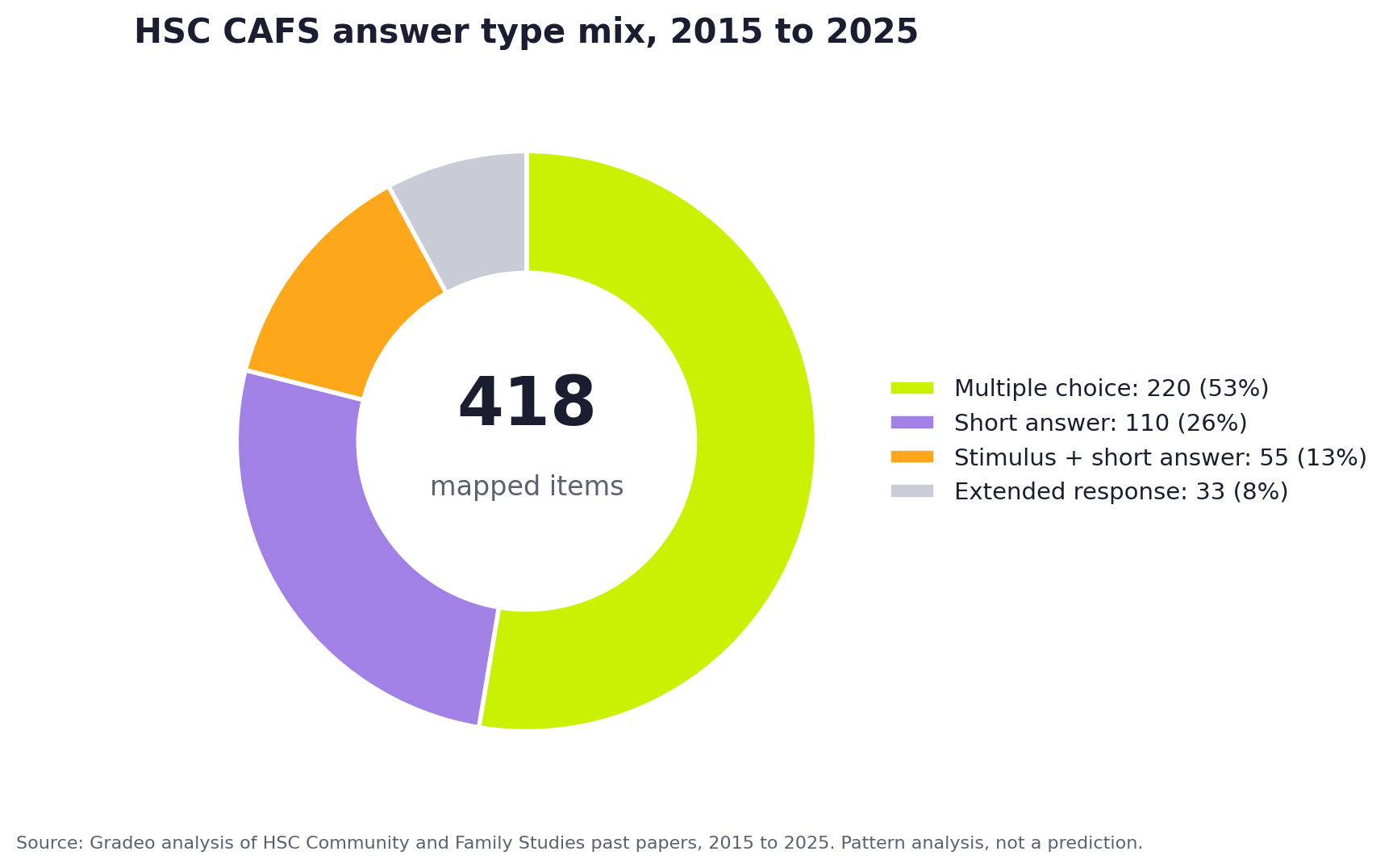
Across 2015 to 2025, the analysis mapped 418 CAFS items. The answer type breakdown was:
The yearly pattern was highly consistent: 20 multiple-choice questions each year, 10 short-answer items each year, 5 stimulus-based short-answer items each year, and 3 extended-response option questions each year.
That structure matters because CAFS preparation should not be built around one type of response. The paper asks students to move between quick knowledge checks, short applied responses, stimulus interpretation and extended writing.
Multiple choice is built into the paper, so the fact that it is the largest item category is not the main insight. The more useful point is that students need to be able to apply course content in different formats, especially in short answer and stimulus-based questions.
The mapping identified 55 stimulus and short-answer items across 2015 to 2025, with 5 appearing in every year. That consistency makes stimulus work a core exam skill, not an occasional add-on.
In CAFS, students may know the topic but lose marks if they do not use the provided stimulus properly. The stimulus is not decoration. It is usually there to shape the response. Students should practise:
This is especially important because CAFS often asks students to apply knowledge to families, groups, communities, research situations or social contexts. The stimulus is often the bridge between content and application.
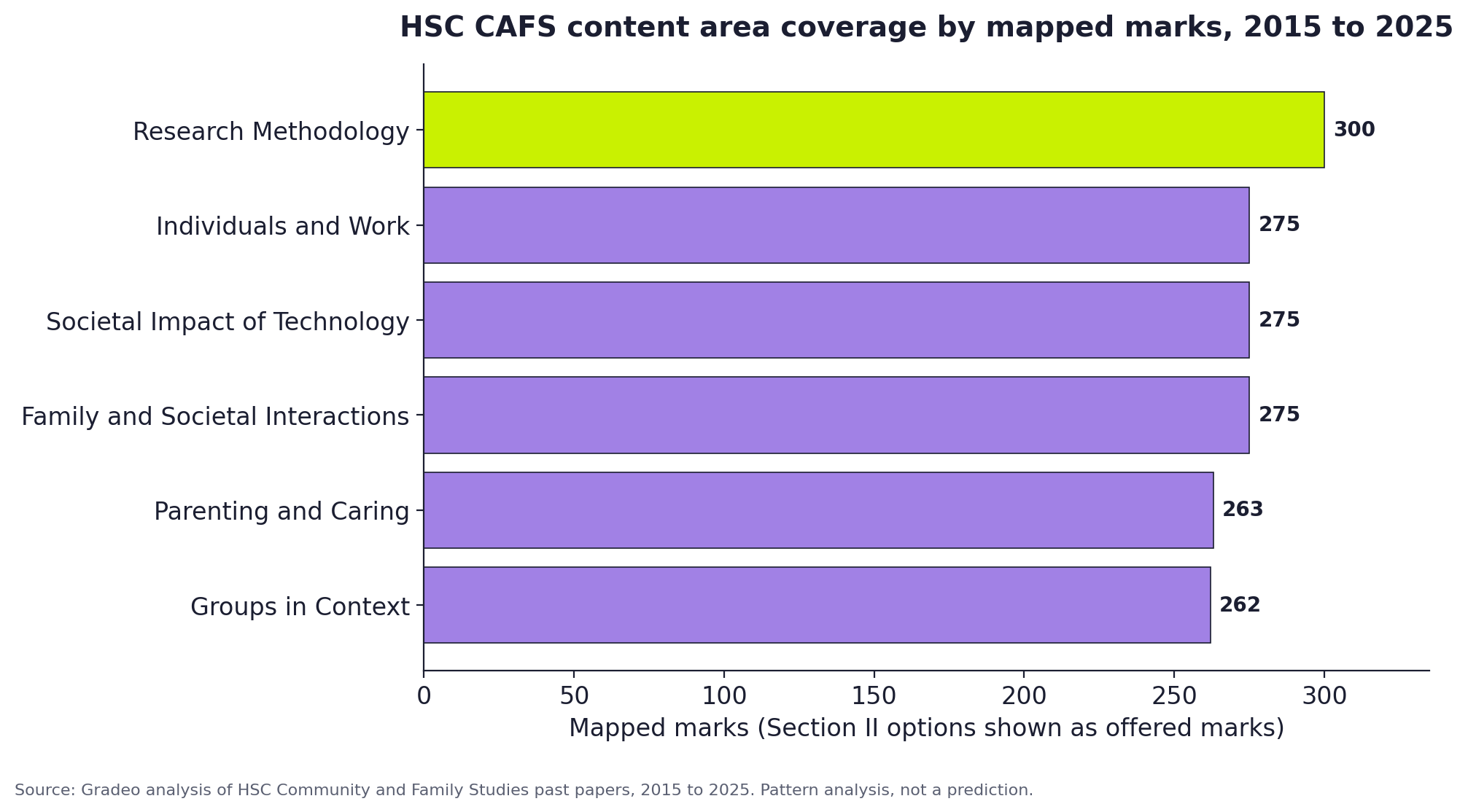
Research Methodology had the highest mapped question count by far, with 151 mapped items and 300 mapped marks. This reflects the way research skills appear across the paper, not just as a standalone content area.
The outcome mapping reinforces this. H4.1, linked to research skills, was by far the most heavily assessed outcome, appearing in nearly a third of mapped questions. It appeared strongly in multiple choice and also featured across written responses.
This is one of the most useful findings for students. CAFS students should not treat Research Methodology as something to revise once and then move on from. It is a recurring skill base for the exam. Students should be confident with:
Research Methodology is a high-return revision area because it supports multiple sections of the paper.
The two other core content areas were also strongly represented. Parenting and Caring had 100 mapped items and 263 mapped marks. Groups in Context had 68 mapped items and 262 mapped marks. The item count is different, but the mapped mark totals are almost identical.
That is a useful distinction. Parenting and Caring appeared more often by item count, but Groups in Context carried almost the same mapped marks. Students should not judge importance by question count alone.
For Parenting and Caring, students should be able to apply concepts to roles, responsibilities, factors affecting parenting and caring, support structures and wellbeing. For Groups in Context, students should be confident explaining needs, access to services, equity issues, support networks, and the circumstances affecting specific groups. Both areas require applied understanding. General statements about families or groups are rarely enough.
The three Section II option topics were evenly represented in the mapping. Family and Societal Interactions, Societal Impact of Technology, and Individuals and Work each had 33 mapped items and 275 offered marks.
This needs to be read carefully. The workbook maps the questions offered across the paper. Students do not answer all three Section II option questions. They answer the option they have studied.
The insight is not that students need to prepare all three options for the exam. They do not. The useful point is that each option has appeared with equal offered mark weight across the period. For students, the priority is depth in their chosen option. For teachers, the data confirms the stable design of the option section.
Explain was the most common directive verb in the mapped period. Across 2015 to 2025, the directive verb counts were:
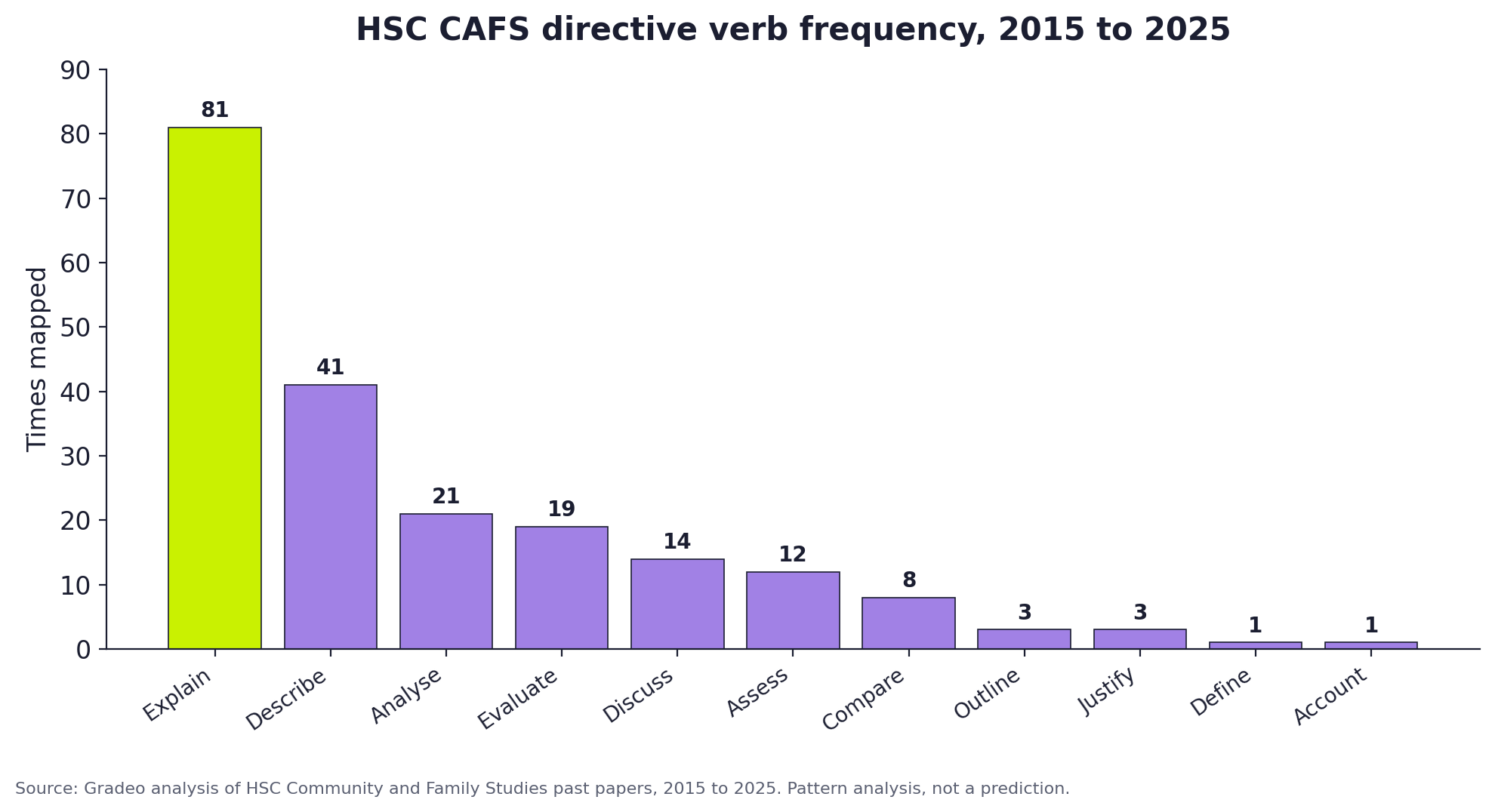
This is a practical finding. Explain appeared nearly twice as often as Describe. That means students need to practise cause, effect, relationship and significance, not just features. A descriptive answer may identify what something is. An explanatory answer needs to show how or why it matters.
For example, if asked to explain how a service supports a group, a student needs to connect the service to the group's needs, access, wellbeing or outcomes. Simply naming the service is not enough.
Analyse, Evaluate, Assess and Discuss appeared less often than Explain and Describe, but they are important because they tend to appear in higher-value written responses, especially Section II options. This matters because option responses require more than content knowledge. Students need to be able to:
A common weakness is writing a prepared option response that does not properly answer the directive verb. Students should practise adapting the same option content to different commands. For example:
That is better preparation than memorising one generic extended response.
The combination of stimulus-based questions, research methodology, core topics and option responses points to a clear pattern: CAFS rewards students who can apply knowledge to context. This is especially true in questions about wellbeing, groups, families, services, technology, work, social change and research. Students should practise moving from concept to application:
That structure helps avoid vague answers.
Students should use this analysis as a preparation check. Useful questions to ask:
The wrong use of this analysis is to try to predict the next paper. The right use is to identify weak response types and neglected skills.
For teachers, the analysis may be useful as a planning check. It can help identify whether students are getting enough stimulus practice, whether Research Methodology is being revisited throughout the year, whether Groups in Context is being under-practised despite its mark weight, and whether option responses are too rehearsed or generic.
It may also support targeted practice. For example:
This analysis has limits.
It is a pattern analysis, not a prediction model.
The CAFS papers from 2015 to 2025 show a highly stable exam structure, with consistent multiple choice, short answer, stimulus-based short answer and extended response components.
The most useful insights are practical. Research Methodology is a persistent content and skills area. Stimulus-based short answer appears every year and should be deliberately practised. Parenting and Caring and Groups in Context both carry substantial mapped marks. The Section II options are evenly offered, but students need deep preparation in the option they actually study.
The directive verb pattern also matters. Explain appears far more often than any other verb, while higher-order verbs such as Analyse, Evaluate, Discuss and Assess are important in extended responses. Past paper analytics can help students and teachers check whether preparation is balanced. They should not be used to predict the next paper.
No. Past papers can show previous patterns, but they cannot predict future papers.
This analysis covers HSC Community and Family Studies papers from 2015 to 2025.
Research Methodology had the most mapped questions, with 151 items across the period analysed.
Research skills appear across the paper, not just in one isolated topic. H4.1 was the most heavily assessed mapped outcome.
Explain appeared most often, with 81 mapped appearances from 2015 to 2025.
Yes. Family and Societal Interactions, Societal Impact of Technology, and Individuals and Work each had 33 mapped items and 275 offered marks across the period.
No. Students answer the option they have studied. The mapping includes all offered option questions.
Practise stimulus-based short answers, revise Research Methodology carefully, prepare your Section II option deeply, and make sure you can explain, analyse and evaluate rather than only describe.
.png)


Book a demo to see how Gradeo can help create, deliver, mark and analyse assessments in one secure platform.
