Join the Gradeo waitlist today.

Past papers cannot predict the next HSC Chemistry exam, but they can show how the current syllabus has been assessed so far.
We mapped HSC Chemistry exam items from 2019 to 2025, covering the current syllabus period. The analysis looked at answer types, directive verbs, modules, marks and syllabus outcomes.
This should be treated as a guide to past patterns, not a forecast. Exam committees change, question design changes, and past emphasis does not guarantee future emphasis. Students should still prepare across the full syllabus and rely on official NESA materials, their teachers and their school's advice.
Across 2019 to 2025, the analysis mapped 302 Chemistry items. The answer type breakdown was:
The multiple-choice count is partly a function of the exam structure, so it should not be treated as the main insight. The more useful point is what happens outside multiple choice. Section II places a heavy demand on students being able to calculate, explain, interpret, write equations, use chemical notation and represent structures accurately.
Chemistry rewards students who can move between words, numbers, formulae and structures. A student can know the theory and still lose marks if they cannot express the chemistry in the right form.
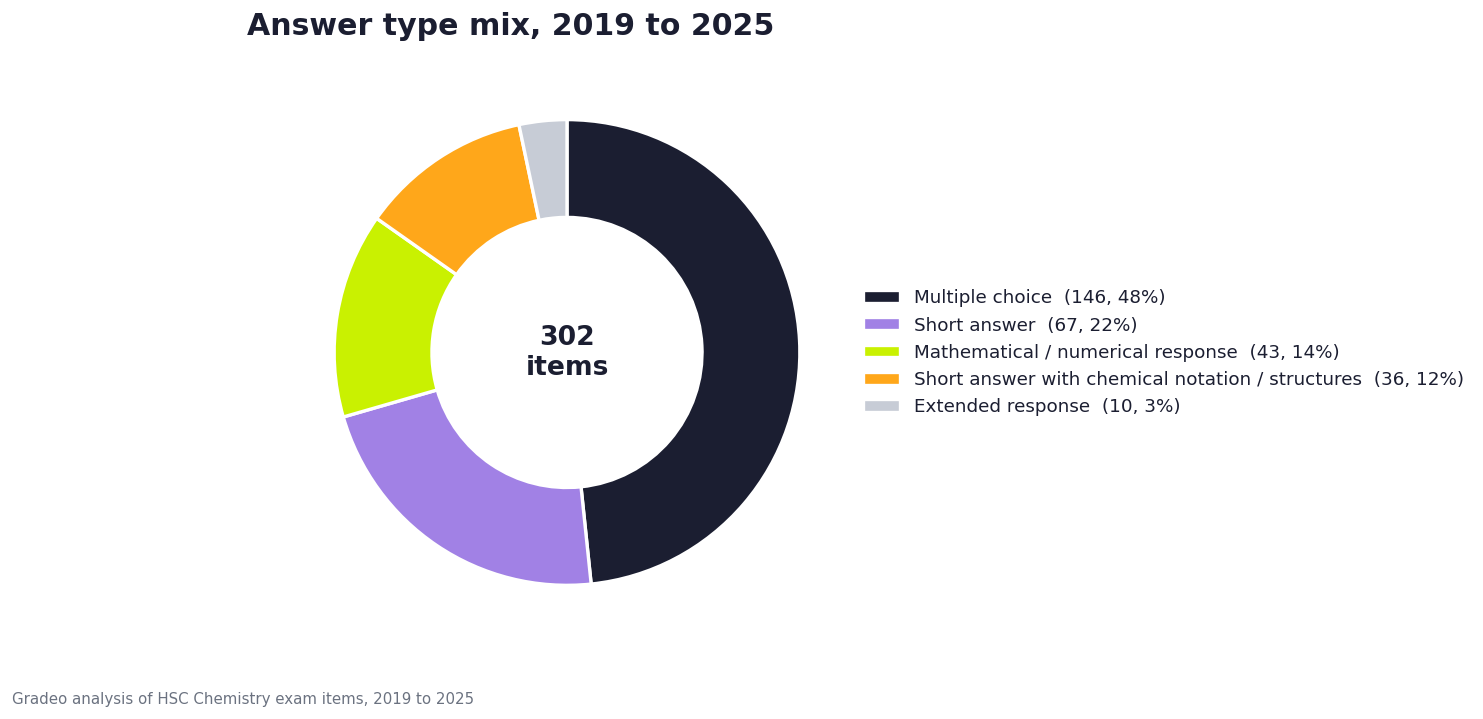
One of the clearest Chemistry-specific findings is the frequency of responses requiring chemical notation, formulae or structures. There were 36 mapped items classified as short answer with chemical notation / structures across the period. That is separate from the 43 mathematical / numerical response items. Together, these make up a substantial part of the written-response demand.
This matters because Chemistry students need more than conceptual recall. They need fluency in the language of the subject:
These are easy areas to under-practise because students often feel they understand the idea. The exam tests whether they can write it correctly.
Mathematical / numerical response appeared 43 times across the mapped papers. That does not make Chemistry a mathematics exam, but it does show that calculation and quantitative reasoning are embedded in the subject.
Students should be comfortable with:
The common weakness is not always the calculation itself. It is often the setup: identifying the right relationship, using the correct units, and explaining what the result means chemically. Chemistry revision should therefore include frequent short calculation practice, not just long content revision.
The directive verb mapping shows that Chemistry questions often combine a lower-order task with a higher-order demand. The most frequent directive groups were:
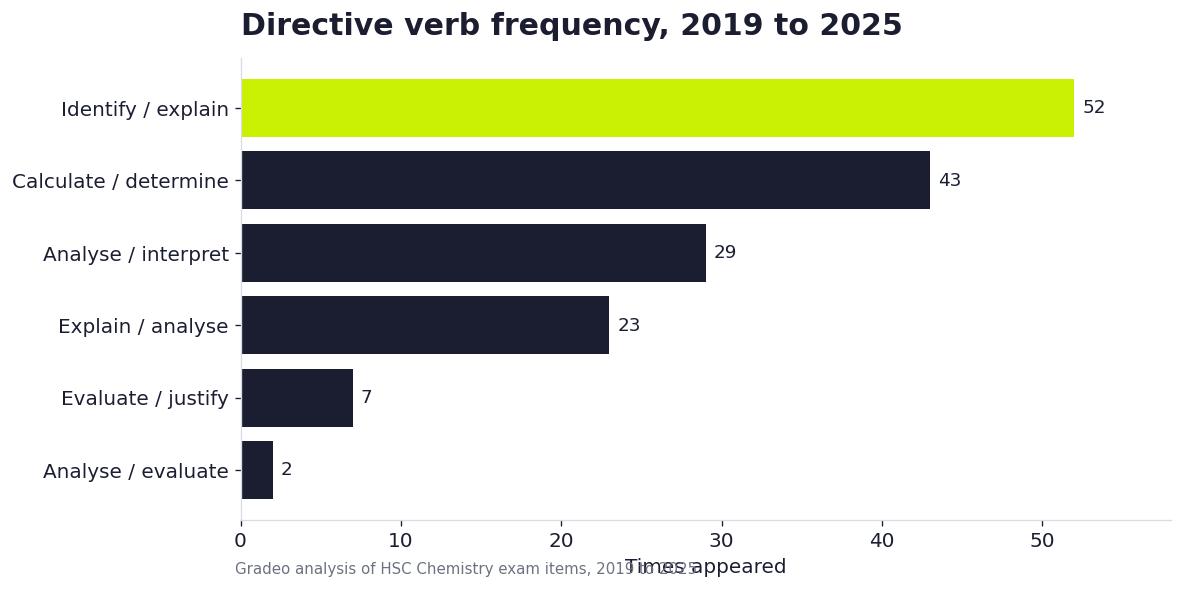
The most useful insight here is that Chemistry questions often ask students to do two things: identify and then explain, calculate and then determine, analyse and then interpret. That means one-step answers are risky. For example, a student may correctly identify a substance, but lose marks if they do not explain the chemical reasoning. Or they may complete a calculation, but not connect it to the question. Students should practise reading the whole directive phrase, not just the first verb.
Using proportional allocation for cross-module questions, the mapped module coverage was:
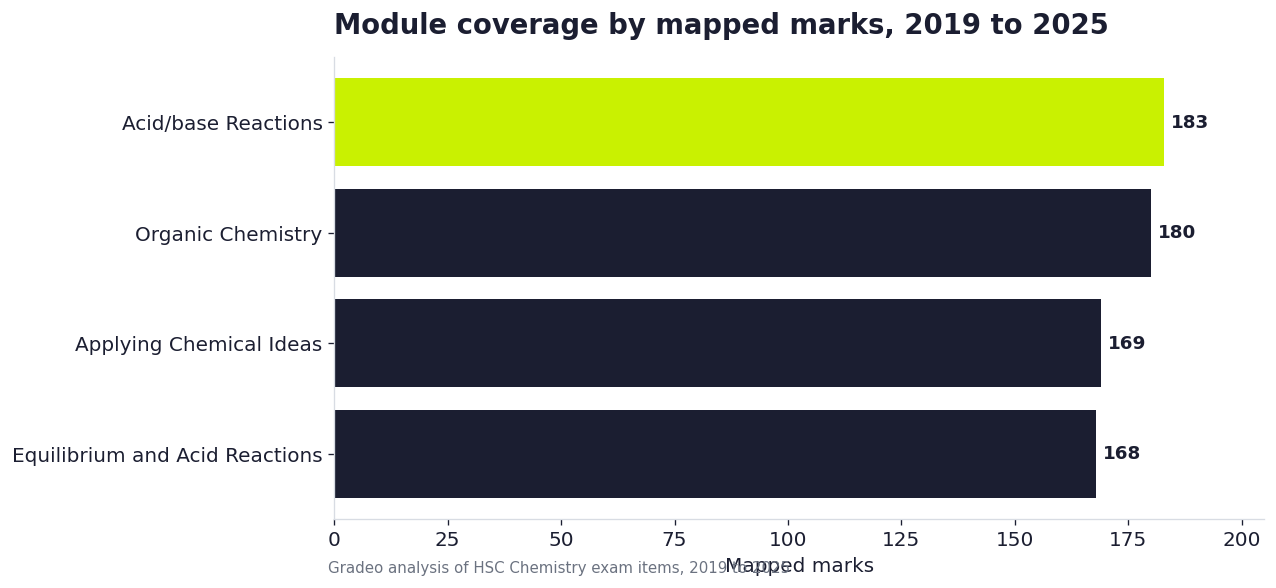
This is a useful distinction. Organic Chemistry had the highest mapped item count. Acid/base Reactions had the highest mapped mark total. Applying Chemical Ideas had the lowest item count, but still carried 169 mapped marks, which is close to the other modules.
The overall picture is relatively balanced. The gap between the highest and lowest mapped mark totals is 15 marks across seven papers. That means students should not use this data to narrow their study. Chemistry has not been assessed in a way that allows safe topic guessing across the current syllabus period.
Applying Chemical Ideas had the lowest mapped item count, with 67 items, but its mapped mark total was still 169 marks. That is important. It suggests students should not dismiss the module simply because it appears less often by count. The items that do appear can carry meaningful marks, and the module often rewards integration, interpretation and application.
Students should be ready to use chemical understanding in unfamiliar contexts, including analysis of substances, qualitative and quantitative methods, and chemical evidence. This is a module where students can lose marks if they only revise content lists rather than practising how to apply chemical ideas to data and scenarios.
The outcome mapping shows strong representation of working scientifically outcomes, especially CH12-6. Across the mapped papers, CH12-6 appeared 55 times in Section I and 69 times in Section II. CH12-5 and CH12-4 also appeared frequently across both sections.
This should not be surprising, but it is useful. Chemistry is not assessed as content recall alone. Students are repeatedly asked to work with investigations, data, analysis, modelling, interpretation and communication. The practical takeaway is that students should practise questions that combine content with evidence. That means:
Students who only memorise module summaries are likely to be underprepared for this style of assessment.
The four module-specific outcomes were all strongly represented:
This supports the same conclusion as the module mark coverage: Chemistry papers across the current syllabus have been broadly balanced across the Year 12 modules. CH12-14 was the most frequent of these outcome appearances, which aligns with Organic Chemistry having the highest mapped item count. However, the differences are not large enough to justify narrowing revision. Students should prepare all four modules and focus on the skills that cut across them: calculation, notation, data interpretation and explanation.
The safest use of this analysis is as a revision audit. Students should ask:
The wrong use of this analysis is to try to predict the next paper. The right use is to find neglected skills.
For teachers, the analysis may be useful as a planning check. It can help identify whether a revision program is too content-heavy, whether students are getting enough practice with chemical notation, whether calculations are being revisited regularly, and whether students are being asked to explain and interpret rather than only identify.
It may also support targeted practice. For example:
This analysis has limits.
It is a pattern analysis, not a prediction model.
The Chemistry papers from 2019 to 2025 suggest a broadly balanced assessment across the four Year 12 modules, with strong emphasis on calculation, chemical notation, structures, explanation, interpretation and working scientifically skills.
The most useful insight is not to chase the most frequent module. It is to practise the forms of thinking Chemistry repeatedly demands: calculate carefully, write chemical notation accurately, interpret data, explain chemical relationships, and apply concepts to unfamiliar information. Past paper analytics can help students and teachers check whether preparation is balanced. They should not be used as a shortcut or forecast.
No. Past papers can show previous patterns, but they cannot predict future papers.
This analysis covers HSC Chemistry papers from 2019 to 2025, the current syllabus period.
Using proportional allocation for cross-module questions, Acid/base Reactions carried the most mapped marks, with 183 marks across the period analysed.
Organic Chemistry had the highest mapped item count, with 84 items after proportional allocation.
No. Coverage across the four Year 12 modules was broadly even. Students should prepare all four modules.
Yes. Mathematical / numerical response appeared 43 times across the mapped papers. Students should practise both calculation and interpretation.
Chemistry often requires students to write equations, formulae, structures and reaction pathways accurately. These are not just presentation details; they are part of showing chemical understanding.
Prepare broadly, practise calculations and notation regularly, and focus on explaining the chemical reasoning behind answers.
.png)


Book a demo to see how Gradeo can help create, deliver, mark and analyse assessments in one secure platform.
