Join the Gradeo waitlist today.


Past papers cannot predict the next HSC Dance exam, but they can show how the subject has been assessed over time.
Dance is different from most HSC subjects because the examination is not mainly a written paper. It includes written appreciation and major practical components across performance, composition and dance and technology.
We mapped HSC Dance examination items from 2015 to 2025 by component, answer type, study area, marks and syllabus outcome. The purpose is not to guess future questions. It is to understand the shape of the assessment and what students should actually practise.
This analysis should be read carefully. Dance has compulsory core components and optional major study pathways. The workbook maps all offered components and options, not just the components completed by one student. Across 2015 to 2025, the workbook captured 2860 offered marks in total, including 660 marks in components completed by all students and 2200 marks in optional offered components.
Students should prepare according to their own selected major study, their teacher's advice, official NESA materials and the marking criteria for each component.
In some subjects, past paper analysis can show shifts in topic emphasis or changing question styles. Dance is different. From 2015 to 2025, the mapped structure was entirely consistent. Each year included the same broad assessment areas:
That means the value of past-paper analysis is not in predicting change. It is in helping students understand the demands of each component. The question is not, what is likely to come up. The better question is, am I preparing properly for the component I will actually be assessed in?
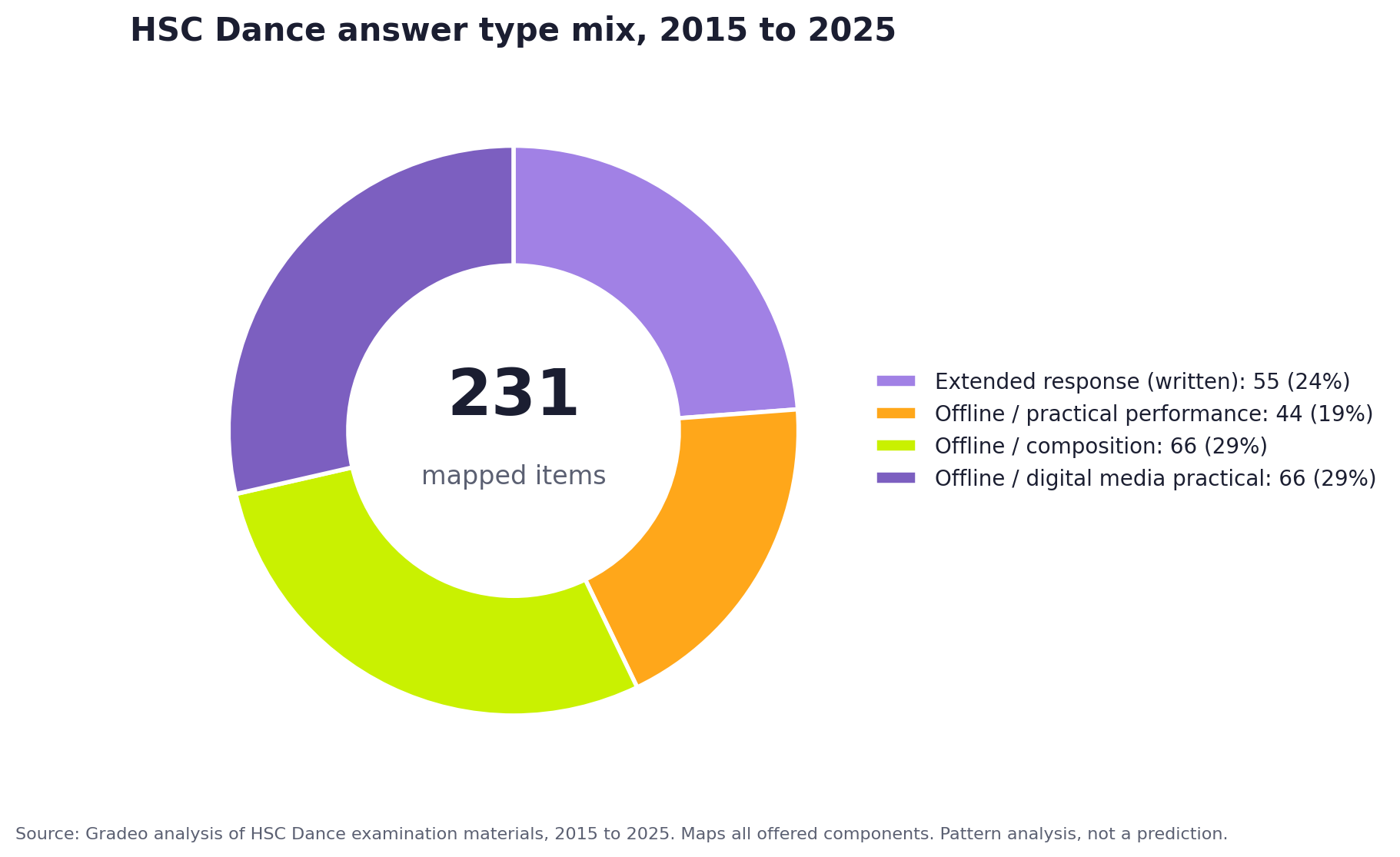
Across the 2015 to 2025 mapping, the answer type breakdown was:
Practical and offline modalities accounted for 176 of the 231 mapped items. Extended response accounted for the remaining 55.
This matters because Dance preparation cannot be reduced to written study notes. The written examination is important, but most mapped items sit in performance, composition or dance and technology pathways. Students need to prepare in the form they will be assessed. For performance, that means technique, control, safe dance practice and expressive quality. For composition, that means choreographic intent, structure, movement choice and the organisation of ideas. For appreciation, that means written explanation and analysis of dance works. For dance and technology, that means using the medium deliberately, not treating technology as an add-on.
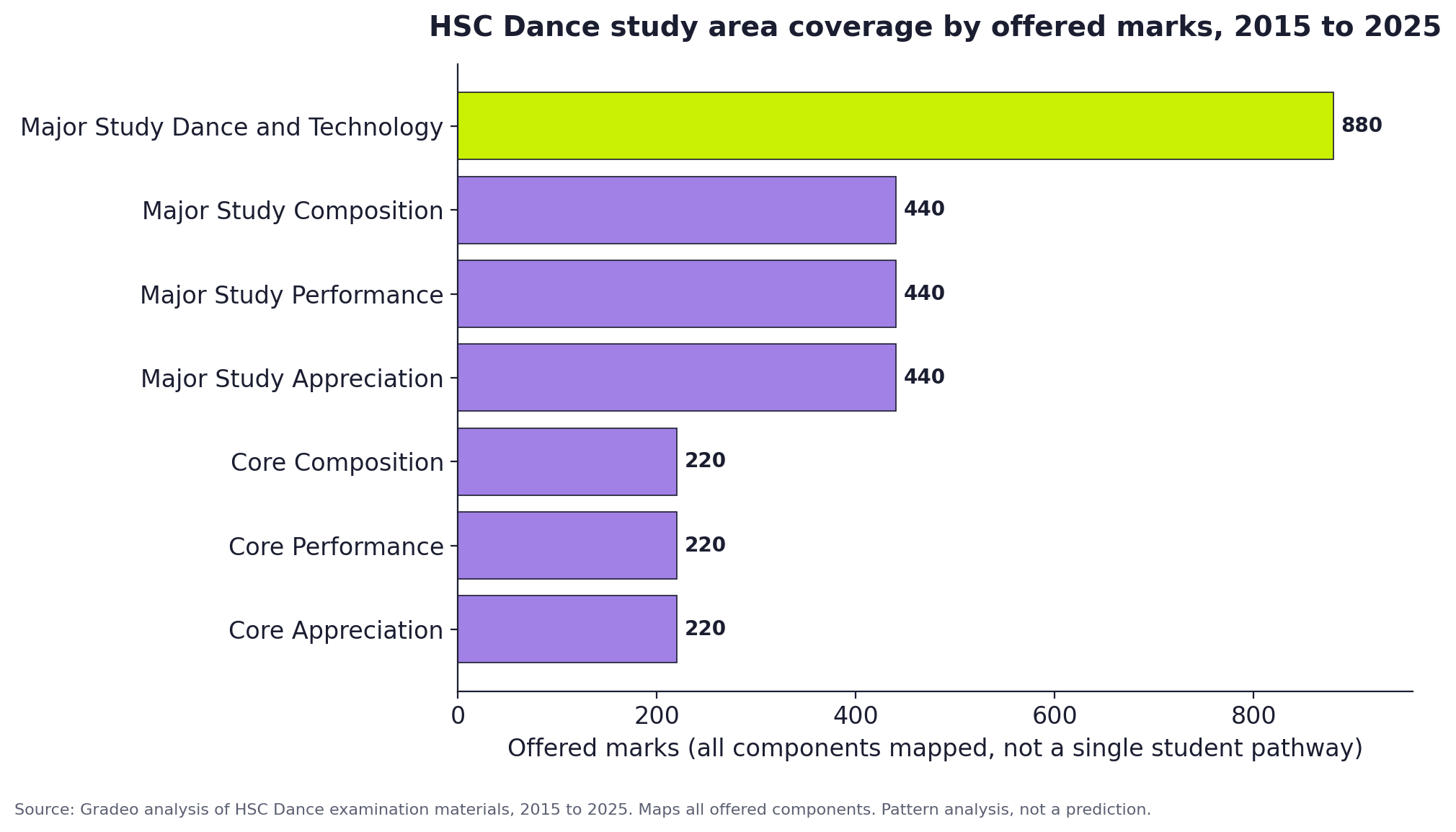
The mapping captures all offered components, which is why the mark totals are larger than the marks completed by an individual student. Across 2015 to 2025, the offered mark totals were:
These figures do not mean every student completes all of these components. Students complete the compulsory core components and their selected major study pathway. The useful point is that the major study components carry greater depth within the offered structure. Core areas establish the foundation, while the major study requires more specialised preparation.
Major Study Dance and Technology had the largest offered mark total in the mapping, with 880 offered marks across 2015 to 2025. This needs careful wording. It does not mean every Dance student should prioritise Dance and Technology. It means that, within the offered option structure, Dance and Technology is a substantial practical pathway.
For students who choose it, preparation needs to be serious and sustained. They need to think about the relationship between dance, technology, choreographic choice, performance material and the communication of ideas through the medium. For students who do not choose it, the insight is different: do not read aggregate offered-mark data as if it applies equally to your own exam pathway.
The written examination covers Core Appreciation and Major Study Appreciation. Across the mapping, written examination components accounted for 660 offered marks: Core Appreciation 220 marks and Major Study Appreciation 440 marks. The written items were all mapped as extended response.
This means appreciation preparation should not be treated as passive revision. Students need to practise writing about dance clearly, using evidence from works, movement, choreographic choices and context. A useful appreciation response should usually show:
Students who know the work but cannot write about it clearly are still vulnerable.
The written directive verb data is less useful than in subjects with fuller written papers. In the workbook, written directive labels included Explain 23, Describe or Explain 1, Evaluate 1, and Review 30. This is partly a mapping and source limitation. Some earlier written-question wording has been flagged for further review in the workbook.
The safe insight is not that one directive verb predicts future questions. The safer insight is that Dance appreciation writing repeatedly asks students to explain or review how meaning is made in dance. Students should therefore practise writing that connects movement, choreographic intent, performance qualities, structure, context, interpretation and evidence from the work. A good appreciation answer should not become a general description of the work. It should explain how the dance communicates meaning.
Core Performance and Major Study Performance were both stable across the mapped period. Core Performance had 22 mapped items and 220 offered marks. Major Study Performance had 22 mapped items and 440 offered marks. The mark difference reflects the greater depth of the major study pathway.
Performance preparation should not be understood as simply knowing the dance. The mapped outcomes show strong links to safe dance practice, technique, performance quality, control, coordination and expressive intention. Students should prepare by asking:
Performance improvement usually comes from repeated, specific feedback, not last-minute rehearsal.
Core Composition and Major Study Composition were also stable. Core Composition had 33 mapped items and 220 offered marks. Major Study Composition had 33 mapped items and 440 offered marks. The higher mark value of the major study again reflects greater depth.
The key preparation point is that composition is not only about having a concept. Students need to organise movement so the concept can be seen, developed and communicated. Strong composition work usually depends on:
A student may have a strong idea but still lose impact if the movement material does not develop or if the structure is unclear.
The outcome mapping reinforces the split between written and practical demands. Written examination outcomes were concentrated around appreciation and communication of ideas, including H1.1 and H4-strand outcomes in the mapping. Practical examination outcomes were concentrated around performance, composition, technology and practical dance skills, including H1.2, H1.4, H2.1, H2.2, H3.1, H3.2 and H3.4.
The practical takeaway is simple: Dance students are being assessed through different kinds of evidence. A strong written response will not compensate for weak practical preparation. Strong practical skill will not remove the need to write clearly in appreciation. The course rewards students who prepare each component on its own terms.
Students should use this analysis as a preparation check. Useful questions to ask:
The wrong use of this analysis is to compare offered mark totals as if every student completes every component. The right use is to understand the assessment architecture and prepare deeply for the pathway that applies to you.
For teachers, the analysis is most useful as a structure check rather than a trend report. It may help with planning by confirming that Dance has a highly stable assessment structure, that practical components dominate the mapped item count, that appreciation writing still requires deliberate practice, that major study pathways need deeper component-specific preparation, that offered mark totals should be explained carefully to students, and that feedback needs to be tailored to the component rather than generalised across the subject.
It may also support practical planning. For example:
This analysis has limits.
It is a structural analysis, not a prediction model.
The Dance papers and marking structures from 2015 to 2025 show a subject with an exceptionally stable assessment design.
The main insight is that Dance preparation should be component-specific. Students need written appreciation practice, but most mapped items are practical or offline. Performance, composition and technology each require different preparation behaviours, and the major study pathway should be treated as a specialist area.
Past paper analytics are useful here, but not because they reveal shifting trends. They are useful because they make the structure clear. Dance students should prepare the component they will actually complete, practise in the form they will be assessed, and use teacher feedback and marking criteria as the main guide to improvement.
No. Past papers and past examination structures can show how Dance has been assessed, but they cannot predict future questions or practical assessment outcomes.
This analysis covers HSC Dance examination materials from 2015 to 2025.
Dance includes compulsory core components and optional major study pathways. The workbook maps all offered components and options, not just the components completed by one student.
No. In the mapping, practical and offline components accounted for most items. Written extended responses are important, but they are only one part of the assessment structure.
Major Study Dance and Technology had the highest offered mark total in the dataset, with 880 offered marks from 2015 to 2025. This is option-specific and does not apply to every student.
Students should practise explaining how meaning is communicated through movement, choreographic choices, structure, performance qualities and context, using relevant evidence from the work.
Prepare by component. Appreciation, performance, composition and technology each require different evidence and different practice.
Teachers can use it to help students understand the assessment structure, the difference between compulsory and optional components, and the need for component-specific preparation.
.png)


Book a demo to see how Gradeo can help create, deliver, mark and analyse assessments in one secure platform.
