Join the Gradeo waitlist today.

.svg)
Past papers cannot predict the next HSC Mathematics Advanced exam, but they can show how the current syllabus has been assessed so far.
We mapped HSC Mathematics Advanced exam items from 2020 to 2025 by answer type, directive style, topic, marks and syllabus outcomes. The point is not to guess the next paper. It is to identify patterns that may help students and teachers check whether preparation is balanced enough.
This analysis should be used carefully. Exam committees change, question design changes, and past emphasis does not guarantee future emphasis. Mathematics Advanced is also cumulative: Year 11 and Year 12 content can both be assessed, so students should not treat Year 12 topics as the whole course.
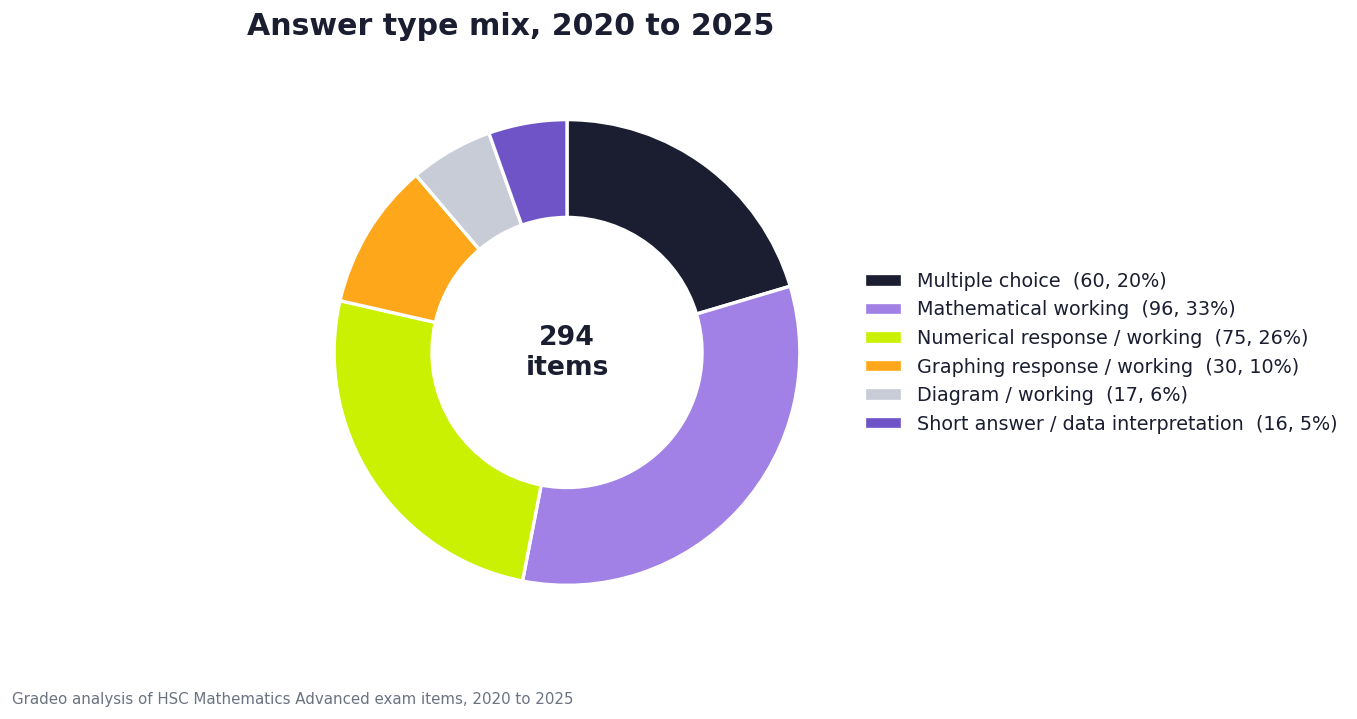
Across the 2020 to 2025 papers, the analysis mapped 294 items. The answer type breakdown was:
The important point is not that multiple choice appears every year. That is part of the exam structure, with 10 multiple-choice questions each year. The real point is that most of the paper requires students to show mathematical process. Outside multiple choice, nearly every item requires some form of working, calculation, graphing, diagram interpretation or written mathematical reasoning.
For students, this means practice should not only focus on getting the answer. Marks are often in the method, the setup, the interpretation and the justification.
Calculus was the largest topic area in the mapping. Across 2020 to 2025, Calculus accounted for:
That is about one-third of the total mapped marks across the six papers. This is a meaningful pattern, but it should not be misused. It does not mean students can narrow their study to Calculus. It does mean that weak Calculus preparation is difficult to hide in Mathematics Advanced.
Students should be confident with:
Calculus is also a topic where partial working matters. A student who understands the process but makes one arithmetic error may still show enough method to earn marks. A student who jumps straight to an answer without clear working is more exposed.
Statistical Analysis was the second-largest topic area by both item count and marks:
This is a strong reminder that Mathematics Advanced is not just algebra, functions and calculus. Students need to be comfortable with data interpretation, statistical reasoning and the language of uncertainty. In practice, that means reading the question carefully and explaining what a result means in context.
Common risks include:
Statistical Analysis is a good example of where students need mathematical fluency and written interpretation.
Trigonometric Functions accounted for:
That is fewer items than Functions, but more mapped marks. This is a useful distinction. It suggests that trigonometry may appear in fewer but more substantial questions. Students who only look at question count could under-estimate its importance.
Students should prepare for trigonometry as a topic that can require multi-step working, graph interpretation and careful algebraic manipulation. It is not enough to recognise standard identities or shapes. Students need to be able to apply them in unfamiliar settings.
Functions accounted for 46 mapped items and 77 mapped marks. Modelling Financial Situations accounted for 32 mapped items and 76 mapped marks. The mark totals are very close, even though Functions appeared more often by item count. This is another example of why item count alone can be misleading.
For Functions, students should practise algebraic manipulation, transformations, inverse relationships, domain and range, and interpreting graphs. For Modelling Financial Situations, students should be comfortable setting up the right model, using formulae accurately and interpreting the result in context. These questions can be deceptively costly if students treat them as simple substitution tasks.
Exponential and Logarithmic Functions was the smallest mapped topic area, with 12 mapped items and 20 mapped marks. This is the clearest low-frequency pattern in the data.
However, it should not become an excuse to ignore the topic. Low frequency does not mean low risk. A small number of marks can still matter, and exponential or logarithmic ideas may also support work in other areas. The sensible takeaway is that students should cover this topic efficiently and accurately, without allowing it to crowd out higher-weight areas such as Calculus and Statistical Analysis.
The outcome mapping shows Year 11 outcomes appearing in both Section I and Section II. That matters because Mathematics Advanced is cumulative. The HSC examination can draw on skills and concepts from Year 11 as well as Year 12.
Students who focus only on Year 12 content may leave gaps in the assumed knowledge that supports harder questions. Functions, trigonometry, algebraic manipulation and mathematical reasoning from Year 11 can all become part of later work. For students, this means revision should include a check of Year 11 foundations, especially where those foundations support calculus, functions, trigonometry and modelling. For teachers, it may be useful to identify whether errors are really Year 12 errors, or whether they come from earlier algebra, functions or trigonometry weaknesses.
The most common directive groups in the mapping were:
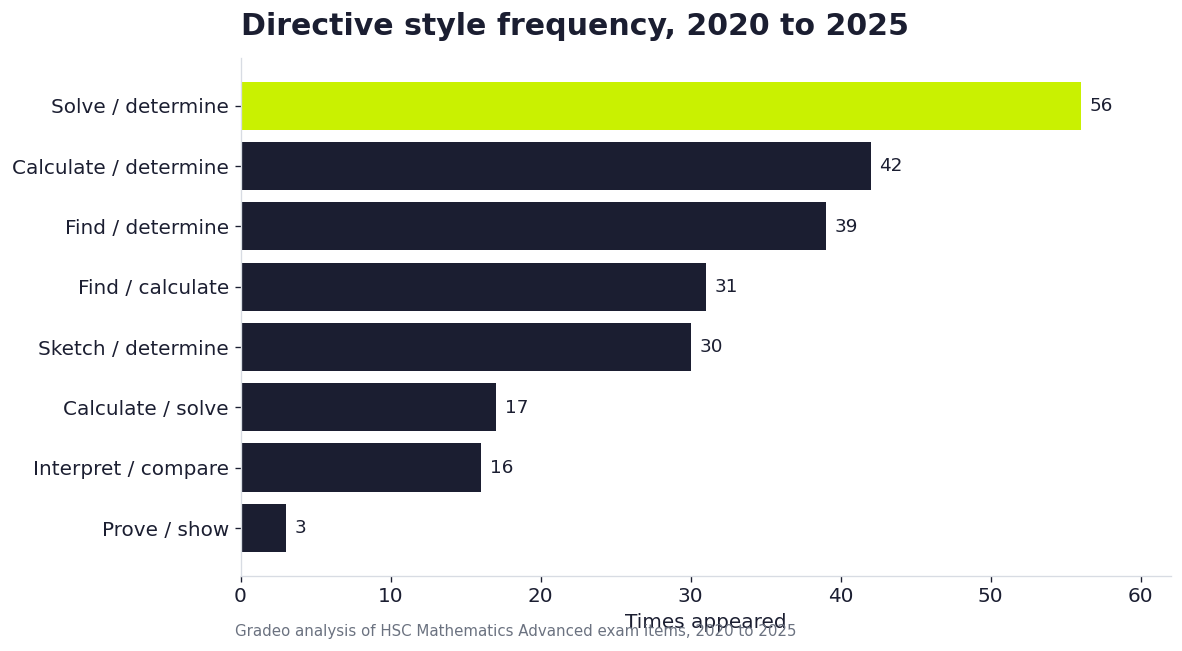
The pattern is clear: Mathematics Advanced questions often combine a task with an expectation that students determine, calculate, solve, sketch or interpret something through working. That means students need to practise setting out solutions clearly.
Good preparation should include:
The directive verbs in Mathematics Advanced may look simpler than in essay subjects, but the demand is still precise. Students need to show the mathematical path, not just the final result.
Graphing response / mathematical working appeared 30 times across the mapped period. Diagram / mathematical working appeared 17 times. These are not the largest categories, but they are important because they test whether students can translate between visual and symbolic forms.
Students should practise:
Some students lose marks not because they cannot do the algebra, but because they misread the graph, draw an unclear diagram or fail to connect the visual information to the calculation.
The safest use of this analysis is as a revision audit. Students should ask:
The wrong use of this analysis is to try to guess the next exam. The right use is to find gaps in preparation.
For teachers, the analysis may be useful as a planning check. It can help identify whether a revision program is too focused on recent Year 12 content, whether Year 11 foundations need refreshing, whether students are getting enough graphing and diagram practice, and whether Statistical Analysis is being treated with enough seriousness.
It may also support targeted practice. For example:
This analysis has limits.
It is a pattern analysis, not a prediction model.
The Mathematics Advanced papers from 2020 to 2025 suggest a strong emphasis on mathematical working, Calculus, Statistical Analysis, and the ability to move between algebraic, graphical, numerical and contextual reasoning.
The most useful insight is not that students should chase the most common topic. They should not. The useful insight is that strong preparation needs to be cumulative and method-focused. Students need Year 11 foundations, Year 12 fluency, clear working, graphing confidence, data interpretation and enough practice across all topic areas to avoid avoidable gaps.
Past paper analytics can help students and teachers check balance. They should not be used as a shortcut.
No. Past papers can show previous patterns, but they cannot predict future papers.
This analysis covers HSC Mathematics Advanced papers from 2020 to 2025, the current syllabus period.
Calculus carried the most mapped marks, with 201 marks across the 2020 to 2025 papers analysed.
No. Calculus is important, but students should prepare across all Mathematics Advanced topics, including Year 11 and Year 12 content.
Yes. Mathematics Advanced is cumulative, and both Preliminary and HSC content can be assessed.
Statistical Analysis had 74 mapped items and 134 mapped marks. It also requires interpretation, not just calculation.
Yes. Graphing and diagram-based responses appeared regularly enough to make them important skills, especially because they test visual and symbolic reasoning.
Show working clearly, revise both Year 11 and Year 12 content, practise Calculus and Statistical Analysis carefully, and do not use past papers to guess the next exam.
.png)


Book a demo to see how Gradeo can help create, deliver, mark and analyse assessments in one secure platform.
