Our launch is coming soon! 58 Gradeo-nauts have joined the waitlist in the last 24 hours.

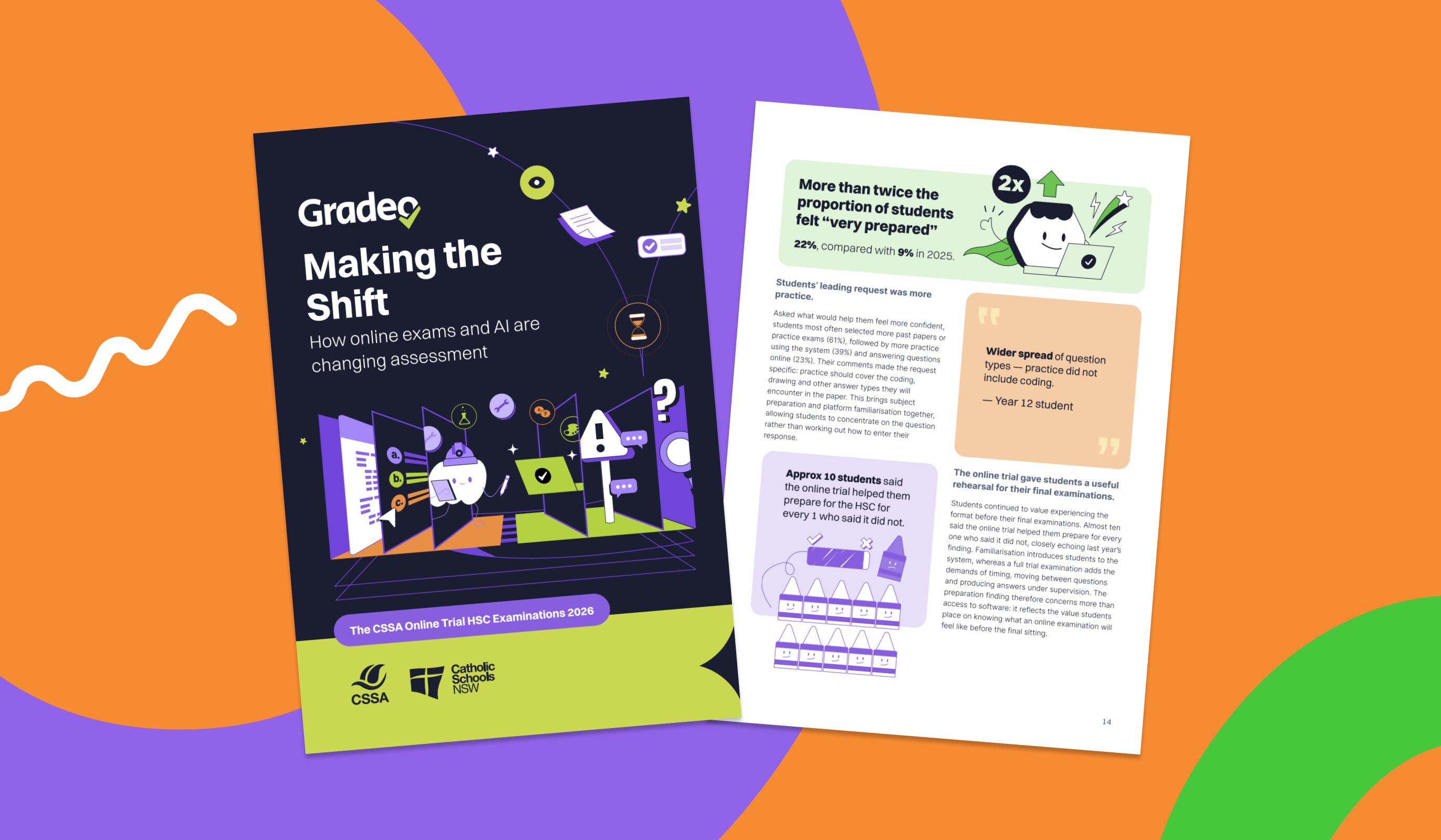
New research from Gradeo finds widespread concern about what take-home work can demonstrate, alongside strong support for assessment redesign and continued preference for typing in supervised exams.
Just one of 167 teachers and school leaders selected take-home written or research tasks among the fairest assessment formats in the age of AI. Only 13% of students selected them.
The finding is among the most striking in Making the Shift: How online exams and AI are changing assessment, released today by Gradeo with CSSA and Catholic Schools NSW.
Drawing on responses from 653 students and 167 teachers and school leaders across 185 schools, the report brings together perspectives from Catholic, government and independent schools in metropolitan, regional and rural communities. It examines how AI is affecting confidence in assessment, alongside a second year of evidence on supervised online examinations.
Almost nine in ten teachers and school leaders (89%) said AI has made it harder to trust that take-home work is the student’s own. Meanwhile, 86% said concerns about AI are narrowing the range of assessment tasks schools can confidently use.
These findings raise a question that extends beyond identifying unauthorised assistance: what can a completed task reliably establish about the knowledge and capabilities of the student receiving the mark?
The report distinguishes between a task’s learning value and its value as evidence of independent capability. An activity may remain worthwhile for learning while requiring additional evidence before a teacher can confidently use it to award a mark.
Among students who described themselves as high-performing or above average, 61% said AI makes it harder for their work to stand out. That compares with 47% of students who described their performance as average.
The finding captures a concern about recognition and fairness, rather than demonstrating that students’ marks have converged. It also shows that questions about assessment credibility are being raised by students themselves.
Across the student survey, 63% said AI use to complete homework or take-home assessment was common among students in their year.
Some 91% of teachers and school leaders agreed that schools need to redesign some assessments rather than rely mainly on detection or enforcement. Better AI detection tools ranked last among nine proposed school priorities.
The report does not advocate replacing every assessment with an exam. It examines how schools can retain a range of assessment approaches while strengthening confidence that results reflect students’ own understanding.
The report also evaluates the 2026 online examination programme, building on recommendations from last year’s Taking the Leap report.
Student ratings improved across all five examination-experience measures and all eleven answer types repeated from 2025. Among students who sat an online exam, 75% preferred typing their HSC examinations to handwriting, broadly consistent with 78% last year.
Teachers reported an average estimated saving of 27 minutes per student per exam through online marking and/or AI feedback. Teachers continued to review feedback and award marks. AI-feedback uptake approximately doubled among exam teachers, with support extending to coding, spreadsheet and diagram responses.
Making the Shift combines voluntary, anonymous surveys with four focus groups, platform telemetry and analysis of support requests. It records both the experience of delivering supervised digital examinations and the broader assessment questions schools are navigating as AI capabilities develop.
For school leaders, teachers and assessment authorities, the report offers evidence to inform decisions about assessment design, preparation, delivery and the interpretation of student work.
[Download Making the Shift: How online exams and AI are changing assessment]
To discuss the findings or arrange a briefing for your school or leadership team, contact Gradeo.



Book a demo to see how Gradeo can help create, deliver, mark and analyse assessments in one secure platform.
